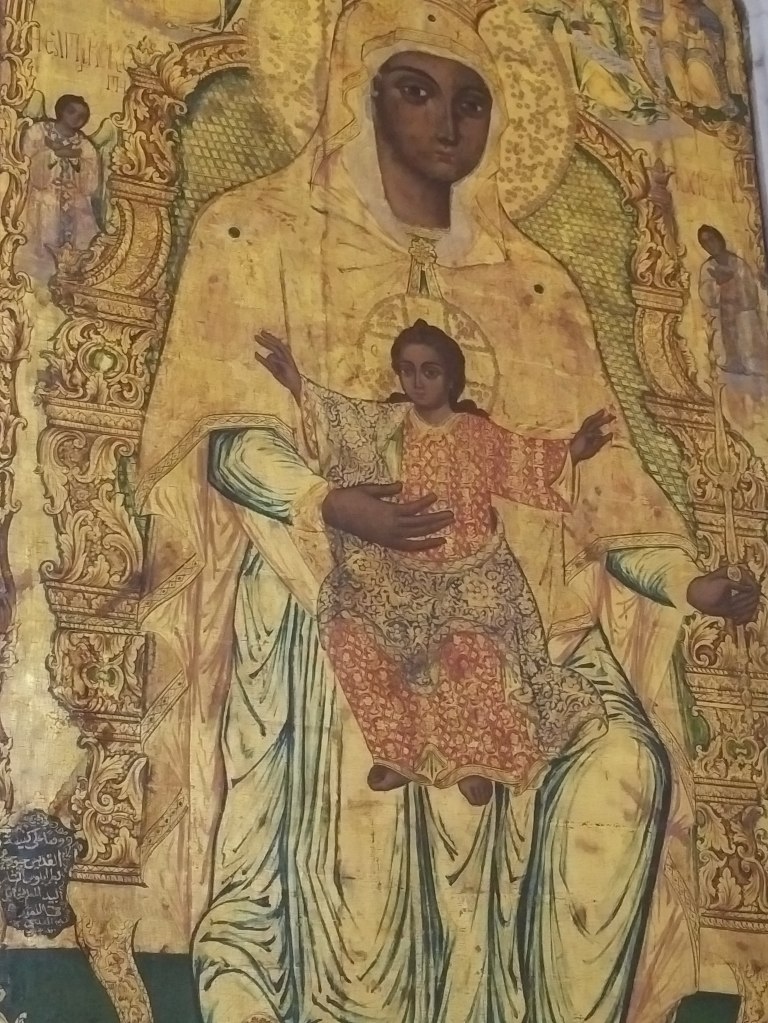
In the city of Tripoli there is humble and almost unknown Black Madonna. She has lain dormant for many years now, but quite suddenly, and rather unexpectedly, she is starting to emerge from the fecund, dark loam of the collective unconscious like a fragile shoot appearing out of frozen soil. The power of the Black Madonna as an agent of change and transformation cannot be overlooked, and nowhere today is this more true than in Tripoli, the second city of Lebanon. So, what does this particular Black Madonna represent, and what is her message to us at this time?
Black Madonna of Tripoli (author’s photo)
She hangs on the wall of the Greek Orthodox Church of St George near the old souk in the heart of Tripoli. She feels slightly incongruous in this poor and very conservative Sunni city close to the Syrian border, where women frequently wear the veil. Dubbed the ‘City of Division,’ Tripoli has gained negative publicity over the past few decades as a place of unpredictable sectarian violence and frequent clashes between Sunni and Alawite rebels or anti/pro Assad factions. It has also historically supported Prime Minister Hariri’s Future Movement. Yet over the past few months the people of this conservative place have been at the heart of the Lebanese anti-government protests.
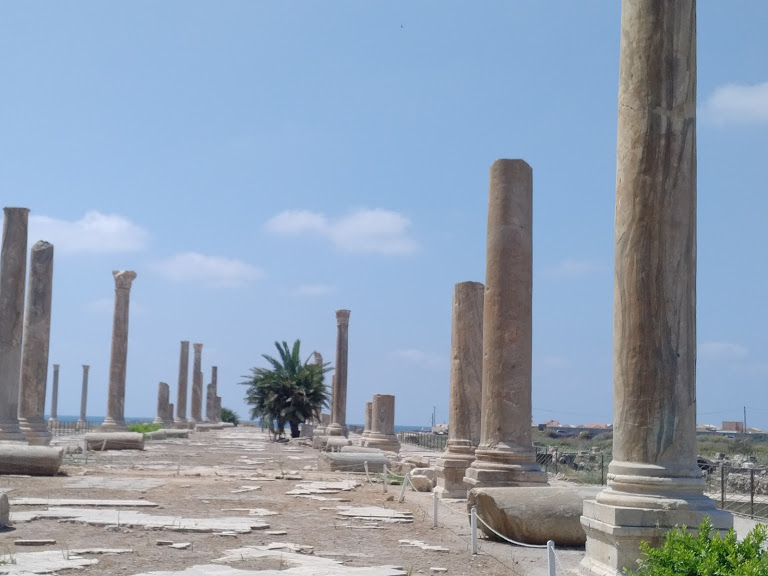
Ancient Phoenician city of Tyre (author’s photo)
Possible reasons for this unexpected behaviour can be found by looking back into the city’s long and illustrious past of dynamism and change. Tripoli was first established as a trading port by the entrepreneurs of the ancient world, the Phoenicians. For hundreds of years, these merchants dominated the seas of the Mediterranean and traded in silver, wood, glass, textiles and of course their hallmark purple dye made from a secretion of the murex sea snail. They invented the alphabet that we use today and ducked and dived at a time when many great civilisations were going into decline. They also witnessed the arrival of new and aggressive players such as Alexander, the Ptolomies, Seleucids, Persians and Romans, and even managed to stay independent to some extent, some of the time. Parallels with today maybe? The Lebanese may be part of the Arab world, indeed at the heart of it, but they also have a different quality and pride themselves as being the entrepreneurs – the ‘middle-men’ of the Middle East.
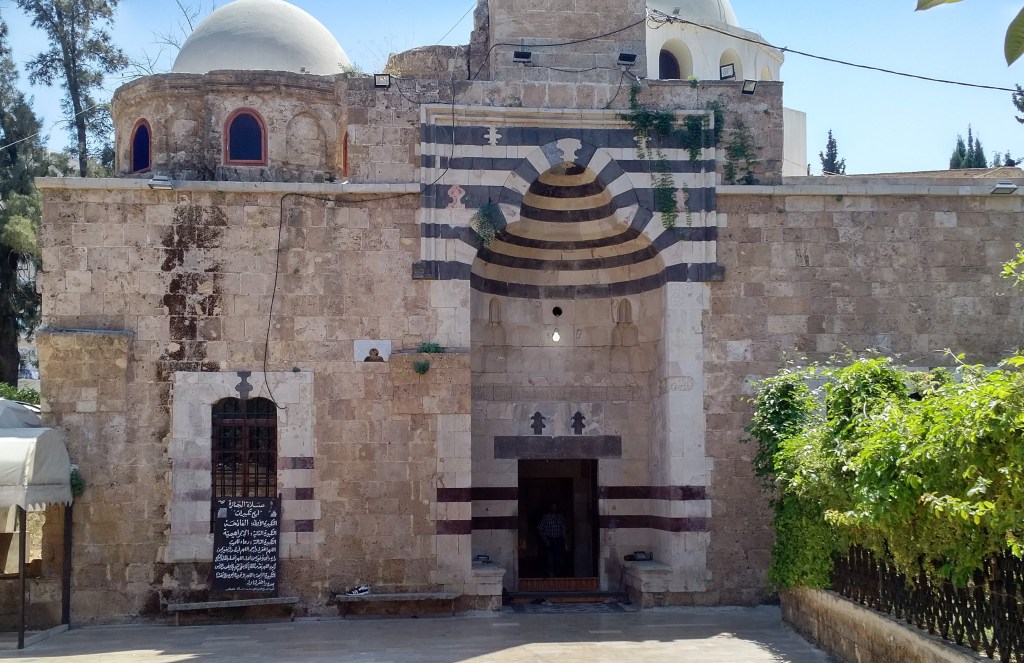
Mamluk era mosque (author’s photo)
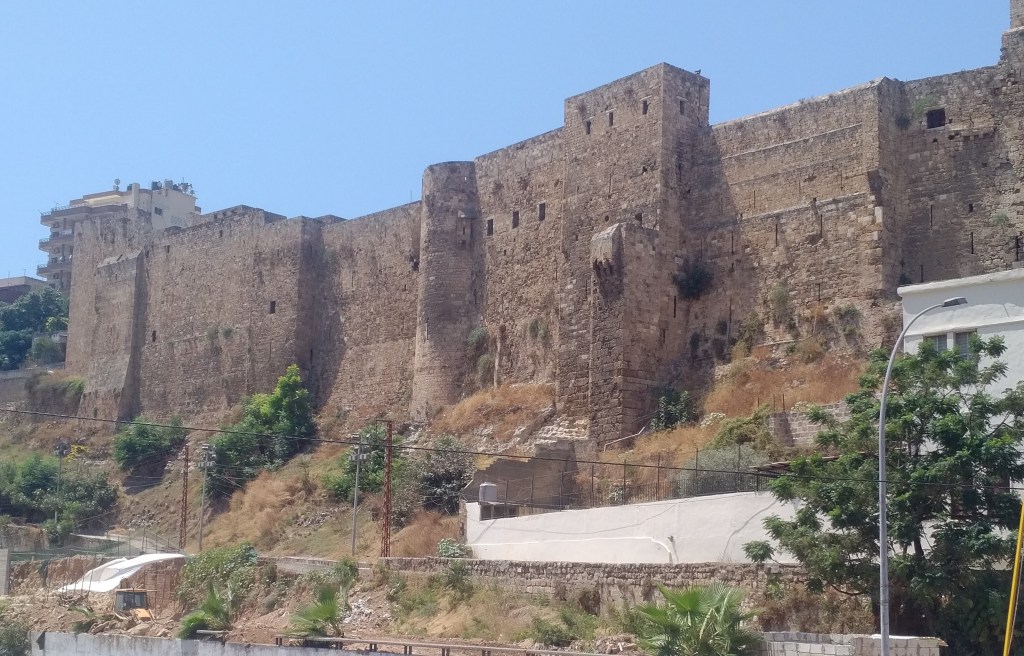
Then in 551 AD, it all changed. A devastating earthquake and ensuing tidal wave swept away all that remained of the ancient world like it had never existed. Nature abhors a vacuum and into this one stepped the next set of invaders, this time from the Muslim world, who in the shape of the Omayyads, Fatimids, Druze, Ottomans then Lebanese, were to dominate the city until today – aside from a period of Western and Mamluk domination, both of which have left physical legacies. The citadel of Raymond of St-Gilles built by the Crusaders still dominates the city, and the Mamluk era mosques, khans and souks make the architecture of Tripoli unique in the Middle East.
Citadel of Raymond of St-Gilles (Qala’at Sanjil)
Though Tripoli’s past has been rich and colourful, the twentieth century has brought with it a fair degree of misery. Sectarian violence had already become a theme at the close of the 19th century with frequent conflict between the Druze and Maronite Christians. When the Maronites began to oppose the then ruling Ottoman Empire, the Western Powers seized the opportunity and intervened, a precdent that was to continue after WW1 when the League of Nations, and Sykes-Picot carved up Lebanon, thereby altering the demographics and sowing the seeds for the devastating civil war of the 1975 – 1990.
To return to the Black Madonna and her message, it is important to understand that the full name of the church in which she stands is the ‘Greek Orthodox Church of Antioch in Lebanon.’ Though obscure today, this church has an ancient pedigree which can be traced back to the very earliest days of Christianity when both Peter and Paul visited Antioch. The church founded at this time became so important that it became part of the Pentrachy – one of the five major episcopal sees of the Roman Empire, which included Rome, Jerusalem, Alexandria, and Constantinople. In time, Rome claimed supremacy over all the other churches with the great schism of 1054 splitting Rome and the Eastern Churches for good, and the rest is literally history.
Hammam in Tripoli, the oldest in the country (author’s photo)
Somehow, the Greek Orthodox Church of Antioch has managed to survive the upheavals of the last two millenia and today its members count for around 8% of the Lebanese population. It has also managed to exist in small numbers in other parts of the Arab world where its’ highly educated and financially adept people have managed, in Phoenician style, to blend into a rigidly conservative and at times fractious religious environment. Most notably, during the Lebanese civil war , the terrible and prolonged sectarian conflict in which over 120,000 people lost their lives, 1 million went into exile and over 76,000 were displaced, the Greek Orthodox community were able to act as negotiators to build bridges between the Maronite Christians and the Arab community at the heart of the conflict.
So, the essence of this Black Madonna is about the preservation of something pure and almost lost, of blending in chameleon-style in hostile environments, and of thriving not just surviving. Of knowing when to lie low and when to step forward and having the courage to do so even when threatened. Of seeking heartfelt, inclusive change that benefits all, not just a minority.
Tripoli protests in October 2019
Over the past few months, the people of Tripoli have been reclaiming their city, resurrecting it from the fragments of division and renaming it a ‘City of Peace.’ Shia, Sunni, Alawite and Maronite are putting aside religious differences to protest against and demand the resignation of a corrupt and ineffectual government. In the words of one protestor, ‘It was always minority causing all the trouble, most people were trying to live their lives…. I always thought people would come together, they just needed a reason.’ [1]
Though this Black Madonna arises from a Christian/Orthodox background, her message transcends religion and draws on a wisdom that resonates with us all at a deep, core level. The protests may have faded in Tripoli for now, but the sentiment behind them has not. People want change and once the nature of this change is formulated coherently, there will be nothing than can get in their way.
[1] Richard Hall, Independent Newspaper, 25.10.2019.
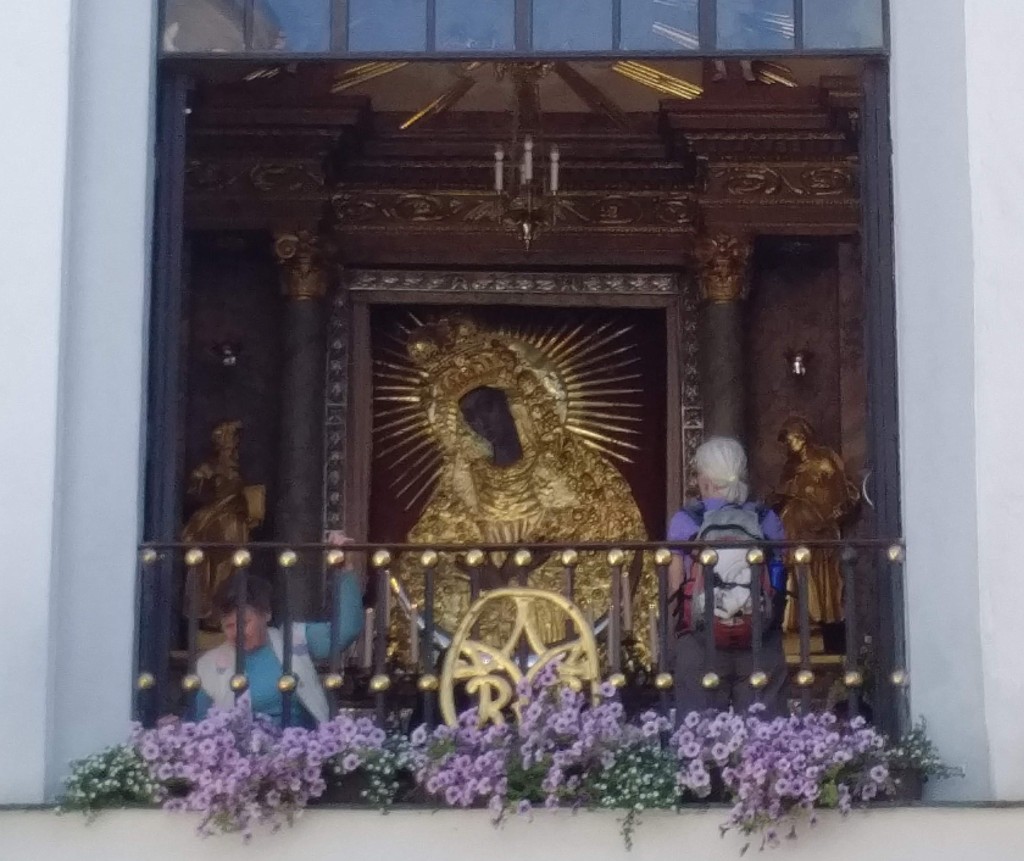
Our Lady of the Gate of Dawn is one of the most beautiful and evocative of Europe’s Black Madonnas. She has presided over the city of Vilnius, capital of Lithuania, for nearly four hundred years and showers her gifts of compassion and mercy from her lofty position on top of the Gate of Dawn on all those who enter and leave. Her story is one of heartbreak and loss, prejudice and politics, love and hope, all intricately bonded with the remarkable history of the city and its’ people. She also sits at the heart of the European landmass, very near to geographical centre of Europe (latitude 54 54 and longitude 25 19), so she is in a sense an omphalos, a microcosm in the macrocosm of Europe’s more recent history.
Our Lady of the Gates of Dawn (author’s photo)
Her origins are shrouded in mystery. She probably emerged around 1630, her painting commissioned by the government of the time, though other legends say that she was brought from the Crimea as war booty. This story hints at Lithuania’s great past when her boundaries stretched from the Baltic to the Black Sea under the days of the Grand Duchy, but by the seventeenth century these days were no more. In any event, after her first appearance she was placed in the Gates of Dawn, part of the city walls, built to protect from invaders. She began to bestow miracles with immediate effect, restoring to health a two-year-old boy who had fallen from a second floor window.
The Black Madonna of Vilnius (photo credit Diana Eder)
By now Lithuania had been swallowed in a union with Poland and Vilnius no longer exercised any real political power. The people would have visited Our Lady to tell her of their woes and reflect on a glorious past long since vanished. But worse was to come. In 1654 the Russians arrived and during the Battle of Vilnius, the city was looted and pillaged, many people taken prisoner and murdered. Carmelite monks were given the task of maintaining the city gates and inherited Our Lady as part of the job. They built her a small wooden chapel which became her home until it burnt down at the beginning of the eighteenth century when the current brick chapel was built. It was during this time that she was to gain her stunning coat of gilded silver, richly decorated with roses, tulips and carnations, and lending her a more Orthodox look.
For the next two centuries Vilnius was to remain under Russian rule, apart from a brief interlude in 1702 when the Swedish army captured the city as part of the Great Northern Wars. Our Lady once again came to the fore. Four Swedish soldiers, who had the impudence to mock and even shoot at her, were killed when the iron gates of the city fell on them. Then, the very next day, the Lithuanian army launched a counter attack against the Swedes, right next to the Gate, and were rewarded with victory.
Over time, Lithuania’s other neighbour – the Prussians – emerged as a military power and she found herself surrounded by aggressive and expansionist neighbours who mercilessly carved her up in the partition of Poland. Repression increased; the Russians clamped down on any rebellion and in 1840 in a bid to try and stamp out any remnants of national pride, the Russian language was made compulsory. The city walls were demolished as a in an act of dominance, but miraculously the Gates of Dawn survived and remains to this day the only surviving part of the defensive walls.
Woman of the Apocalypse
Throughout the trials and tribulations of occupation, war
and repression, the faithful continued to pray to Our Lady for her benevolent
intervention and brought her votive offerings of cured limbs, eyes, and many,
many hearts. It was during this time that she inherited her splendid silver
crescent moon, earning herself the title of Queen of Heaven. With her golden
crown and halo, the twelve stars around her head and the moon beneath her feet,
she became associated with the Woman of the Apocalypse in the book of
Revelation.
Jewish Quarter, Vilnius (author’s photo)
By the end of the nineteenth century, Vilnius had become a major Jewish centre. Forced to live within the Pale of Settlement in the Russian Empire, many Jews were attracted to Vilnius with its railway network and thriving business centre and by 1870 they comprised half of the population of the city. The Jewish quarter was a bustling place where furriers, opticians and goldsmiths plied their crafts, and moves were afoot to build a large synagogue to facilitate their worship. But anti-semitism also thrived and organised pogroms and acts of extreme violence against the Jews became more frequent on the streets around the Gates of Dawn. Many tried to emigrate, but those that remained were to face the then unimaginable horrors of the twentieth century.
After the outbreak of the First World War, Vilnius was
occupied by the Germans, then in 1918 with both the fall of the Tsarist Empire
and the collapse of the German Empire, the city finally and jubilantly declared
independence. Sadly, this was not to last. The city was annexed in 1920 by the
Poles, and for the next 19 years Vilnius became part of Poland, cut off from
the rest of Lithuania and ruled over once again by outsiders. The people turned
again to Our Lady in their hour of need and in 1927 she was crowned formally as
the Mother of Mercy.
The twentieth century was to wreck worldwide havoc with its
mass murder, unimaginable scale warfare, disease and genocide and Vilnius
played out its role as microcosm to the macrocosm of European/world politics. One
of Lithuania’s most famous daughters, the renowned archaeologist and thinker
Marija Gimbutas lived during these times. She was born in Vilnius in 1921 to
doctors, who had founded the first Lithuanian hospital and were themselves strongly
involved with the folk history and culture. The young Marija would have almost
certainly visited Our Lady, though there are no formal written records of this.
Under Polish rule, the family moved in 1931 to Kaunas but
Marija was to study in both Vilnius and Kaunas where she embarked on her
studies of the Ancient Balts and their Indo-European ancestry, a theory for
which she is now famed. Vilnius was not to return to Lithuanian control until
World War Two, when the Russians, this time in the guise of the Communist
Soviets, took control of the whole country including the former capital. But
fortune proved once again fickle, and with the Nazi invasion of the Soviet
Union in 1941, Lithuania now found herself ruled by an even more aggressive
master.
Paneriai Forest Memorial (author’s photo)
Almost immediately the next tragic stage in Vilnius’ history began – the mass murder of its vast Jewish population. Already segregated in ghettos near the Gates of Dawn, the Jews were systematically liquidated. The first stage was transport to the forest of Paneriai just outside Vilnius where around 100,000 people were shot and buried in mass pits over the course of the war. In 1941 over a three-month period, half of the Jews of Vilnius had been massacred at this site alone. The deportations must have occurred within sight of Our Lady, but sadly no intercession was forthcoming on this occasion.
Nuclear silo, Zemajitija National Park (author’s photo)
By the end of 1944, Europe was on her knees and the Reich that was to last a thousand years came crashing down. Out of the ashes of chaos, a new threat was emerging and in 1945 Vilnius came come back under Soviet control once again. Regarded as the worst of all foes by some, Gimbutas chose to flee the Soviets and sought haven in the ruins that was Germany with her manuscripts under one arm and her baby under another. The people of Vilnius now faced life under the Stalin and thousands of Lithuanians were murdered, imprisoned or deported under his rule of political terror. Many would have turned to Our Lady for comfort and mercy and to feel her boundless compassion during the spiritual sterility of the Cold War, when tension was always high between East and West. Unbeknown to anyone, four nuclear warheads pointing at European capitals were stationed in the forests of Lithuania after the stand-off of the Cuban missile crisis and remained perilously positioned there for over a decade.
Our Lady of the Gates of Dawn (author’s photo)
Finally, in 1989 the opportunity to shake off Soviet repression presented itself and the Lithuanians were in the vanguard. Under the Glasnost of Gorbachev, the Warsaw pact countries began to open their borders and align themselves to democracy. The people of the Baltic States, who actually comprised part of the Soviet Union at the time, formed a Chain of Freedom of over two million people from Tallinn to Vilnius. Seven months later, Lithuania was the first of the Soviet Republics to declare independence. In 1990, for the first time since the thirteenth century, Lithuania became an independent country and the smile of Our Lady of the Gates of Dawn seemed to become more serene. She can now be visited by anyone at most hours of the day and night, always available with her boundless compassion, fully at home in her role as Queen of Hearts and the Lady with the Moon at her feet and stars in her hair.
Prophecy is one of the most ancient of all the human art
forms, yet probably one of the most misunderstood. Today it is largely
relegated to astrology columns in newspapers, or maybe the occasional tarot
card reading, and certainly peripheral to most peoples’ daily lives. Throughout
the ancient world, however, it was mainstream, the grease that oiled the cogs
of state and gave succour to many a great statesman. Indeed, the oracles could
be considered as the ancient equivalent to Google, the place where everyone
went to find knowledge, to exchange ideas and to generally hook up with other
like-minded people. But what powered the sites themselves? What enabled one
site to be used as an oracle when another could not?
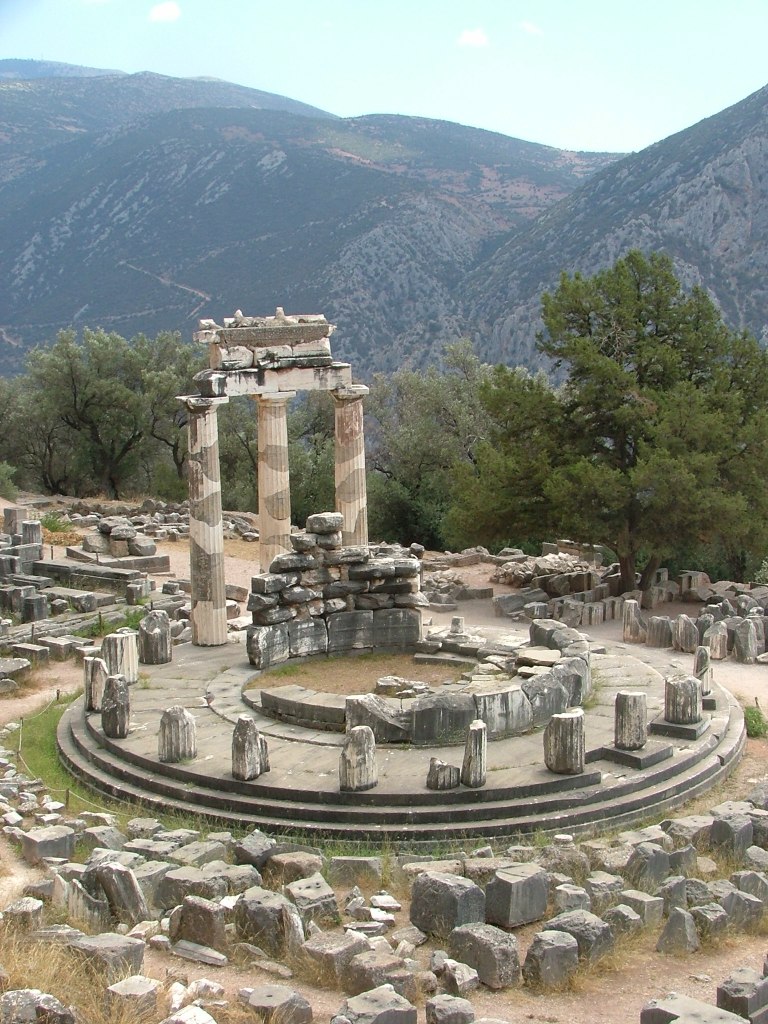
Tholos at Delphi (Wiki Commons)
Though oracular prophecy predates the ancient Greeks and Romans, it was their temples and myths that preserved the ancient oracular sites, and some of the mystery surrounding them. Apollo was the Greek god of prophecy and the most famous oracles were presided over by him. But this hadn’t always been the case. In archaic times, the oracles were dedicated to Earth goddesses, and presided over by priestesses who had access to the voice of the Earth, usually operating out of groves or simple sanctuaries. The myths tell us that before Apollo could take them over, he had to subdue the serpent Python, which he pursued to Mount Parnassus, then into the shrine at Delphi itself, ‘where he dispatched it beside the sacred chasm.’ As Graves suggests, this mythic takeover of Delphi probably records the historic invasion of the Northern Hellenes of pre-Hellenic cultures. As part of the takeover process, they killed the sacred oracular serpent that was kept in the sanctuary of the Earth goddess.[1]
‘Lilith’ by John Collier
Snakes are one of the most primal symbols of Earth energies. They live close to the ground, sense vibrations, and move in a sinuous wave akin to the way in which energy moves. Though the Earth energies are not visible, anyone looking at the waves on the sea could easy make the link between waves, and the way they embody form and movement, long before modern science mapped them. They can also survive beneath the ground for long periods, only to emerge in unpredictable and terrible ways, like the restless forces from within the Earth. Indeed though Apollo is said to have killed the Python, he retained the services of the oracular priestess who were themselves called ‘Pythia’ and it is highly likely that snakes were kept in the sacred tholos at Delphi well into Hellenistic times.
The Python that Apollo subdued was also known as a Dragon,
and it was this Dragon that was said to have chased Apollo’s mother Leto around
the Earth as she tried to give birth to him. This was clearly no ordinary
snake, but one of mythic proportions, and I couldn’t help wondering if this was
a metaphor for the seismic energies of the Earth itself, which Apollo must subdue
if he was to use them. This was an issue I had been pondering for a while, and the
opportunity to find out more presented itself on a recent trip to western
Turkey.
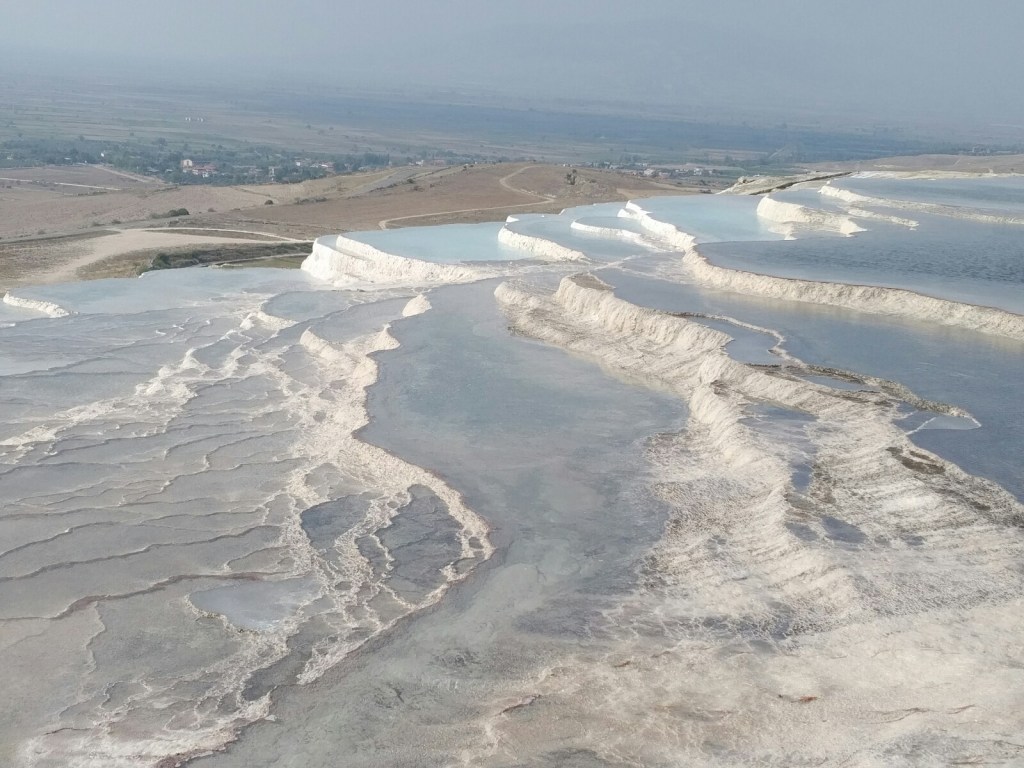
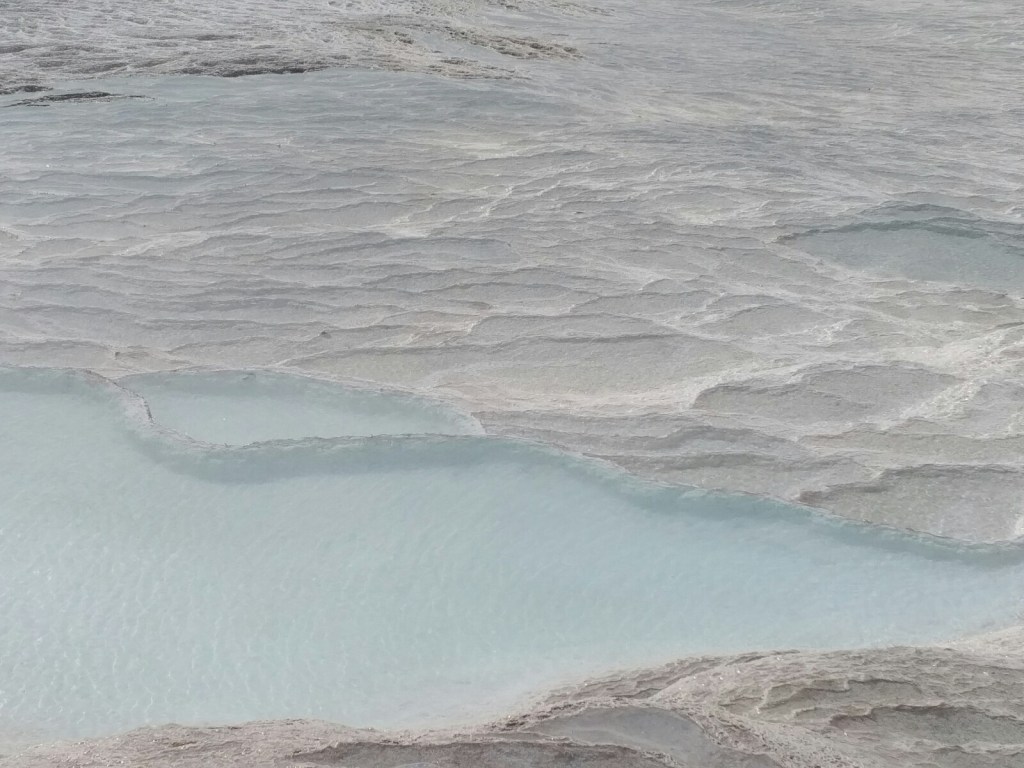
Travertine, Pamukkale (author’s photo)
Hierapolis is not a name that is familiar to most people, but everyone has heard of Pamukkale. Though remote, more than 140 km from Izmir, over two million people visit this site every year and enjoy the thrills of dipping in the blue mineral waters that cascade over the calcareous deposit known as travertine. But not many people are aware that there was also an ancient oracle at this site, known throughout the ancient world as the Gateway to Hell. As I was to discover, this is no coincidence, for the same geological features that gives rise to the amazing mineralogy and healing waters of Pamukkale also powered this mysterious and most primal of oracles.
Mineral waters of the Travertine (author’s photo)
Turkey has frequent earthquakes because the Anatolian plate on which it sits is squeezed between the mighty African and Eurasian plates that are moving in opposite directions. Pamukkale is not situated on a plate boundary, but near a meeting point of four Graben, areas of multiple faulting and rifting caused by these plate movements. At Pamukkale, the crust has thinned as a result of the tortuous stretching of the Anatolian plate so much that it has fractured, resulting in a network of faults and fissures. Hot water from the mantle percolates through the crust, bringing with it the minerals dissolved from the local limestones, and deposits these on the surface in the form of the milky white travertine that visitors come from far and wide to see. In addition, a cocktail of noxious gases are discharged as the hot mineral rich fluids reach the surface and today, close by to the translucent blue pools in which these visitors dip, taps are visible that vent discharging gases such as carbon dioxide and sulphur dioxide, make the place safe to visit.
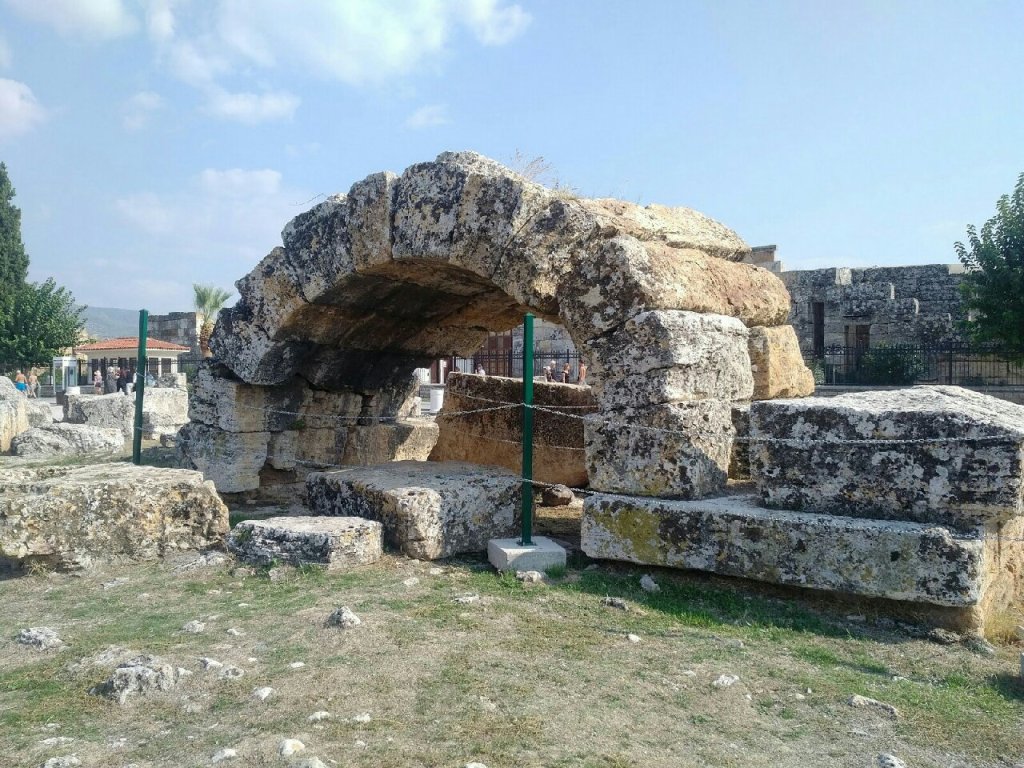
Remains of the Plutonium, Hierapolis (author’s photo)
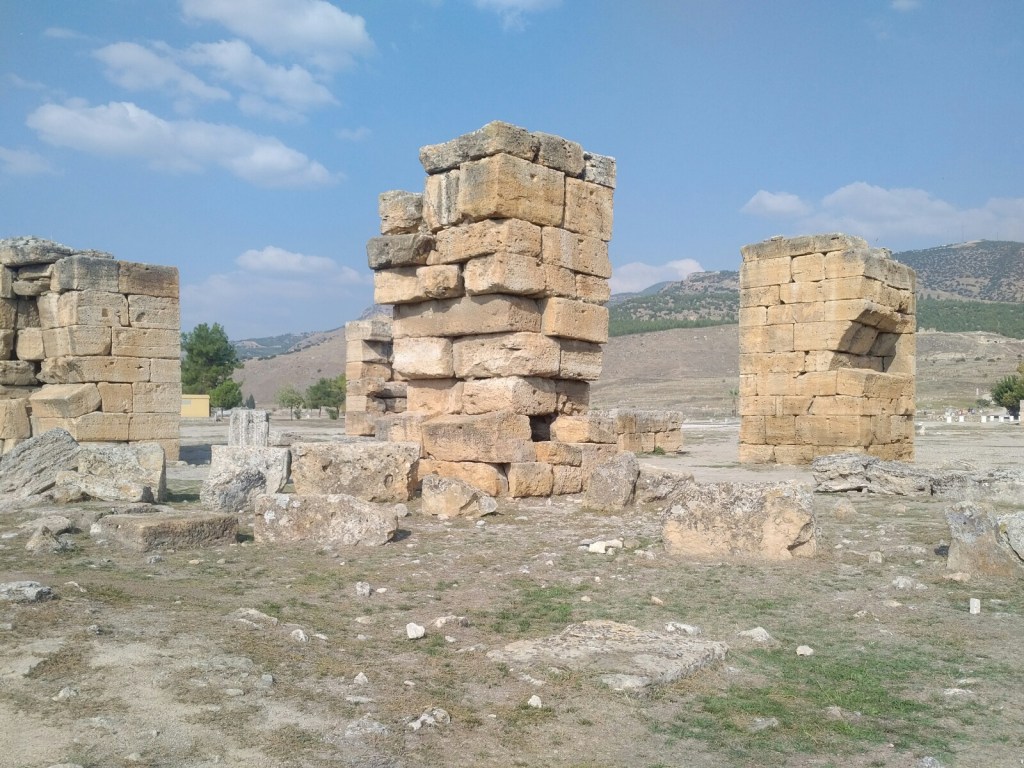
In ancient times, this ancient chasm in the land, as well as its noxious gases and beautiful minerals, would have been sacred to our ancestors and a cult site was located since time immemorial dedicated to Cybele, the ancient Anatolian mother goddess and her priests, the castrated Galli, would have officiated. With the arrival of the Hellenes and then the Romans, this mysterious site where Earth processes could be seen and smelt became associated with an entrance to the Underworld, but still considered sacred as the name Hierapolis (or sacred city) implies. A temple dedicated to Pluto and his consort Kore, the equivalent of Persephone and Hades in Greek myth, was built over the sacred chasm and appropriately named the Plutonium. Guarding the entrance to the Underworld was Cerberus the three headed dog and a snake, still retaining its status as a prime Earth energy symbol. A nearby temple of Apollo took over the oracular function in the form of Apollo Lairbenus, whose mother Leto was equated with the ancient earth goddess Cybele.
Temple of Apollo (author’s photo)
Accounts from Strabo of how priests would go into an underground chamber with a deep cleft in the rock, through which flowed a fast running stream, and come out to utter prophecy suggest that they used the noxious gases as a sort of trance inducer. It is possible also that small animals were used to indicate levels of the gases, much as canaries were later used underground to warn miners. [2]
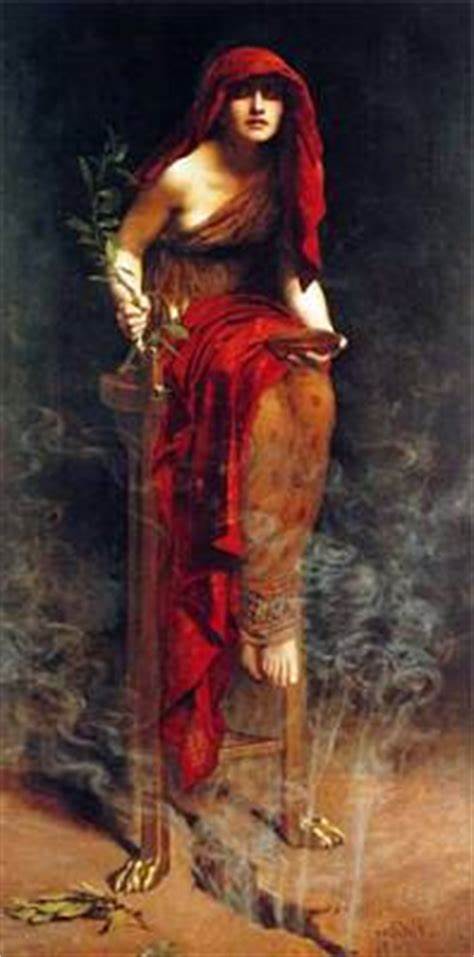
Priestess of Delphi, John Collier (1891)
The chasm at Hierapolis is reminiscent of the description of the sacred chasm at Delphi in the myth of Apollo and Python, and indeed Mount Parnassus is located in a seismically active part of Greece. Modern research has shown that the site was built over a volcano related fissure that discharged gases through the springs percolating through the rocks, either in the form of ethylene or methane. [3]The Pythia would have sat on a tripod over this chasm and uttered her prophecy in an altered state of consciousness, literally induced by the Earth energies. Interestingly this was exactly how John Collier depicted her in his iconic painting of 1891.
The connection between seismic activity and oracular sites was beginning to look far from coincidental. It was apparent that ancient people noticed the connection between springs, gases and earthquakes and deemed the chasms associated with them to be highly sacred, as well as mysterious. They placed sanctuaries and later temples on these gateways to the Underworld, where the voice of the Earth itself could be heard, and it was the dragon or serpent that came to symbolise this seismic activity.
I knew there were two more famous oracles on the Turkish Aegean coast, at Didyma and Claros, and it was there I journeyed next to further investigate the link between dragon energies and oracles.
[1] ‘The Greek Myths’ by Robert Graves, Penguin 1992
[2] ‘Blue Guide Aegean Turkey: from Troy to Bodrum,’ by Paola Pugsley, 2018
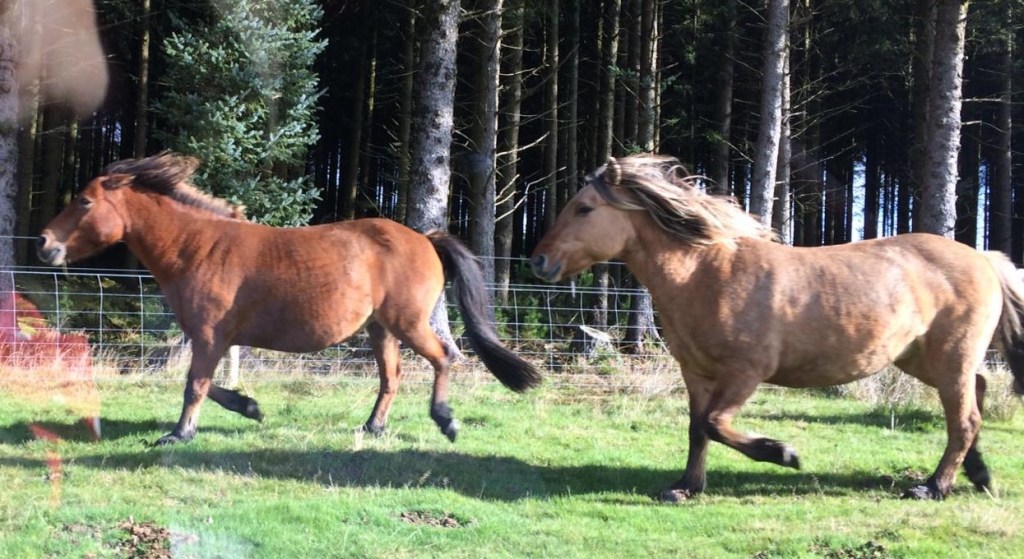
Autumn was just beginning to draw its golden curtain across Dartmoor and a few trees had already begun to shed their leaves. We spent a wonderful morning exploring the tiny back lanes of the Moor, finding wells and stone circles, the places where great rivers rose and merged, and watching as ponies were rounded up for their yearly count. Then we brought out attention back to the Mary and Michael currents, which cross across the northern part of Dartmoor quite close to our accommodation at Shilstone Farm.
Nine Maidens Stone Circle, Dartmoor (author’s photo)
First stop was the evocatively named Belstone, resonating with the fire god Bel, also known as Baal in the Middle East. It was this enigmatic god, mentioned in the bible as the arch-enemy of Yahweh, who became intimately connected with the fire ceremony of Beltane throughout the ancient world. After a brisk walk across the Moor we ended up at the Nine Maidens stone circle just beneath the Belstone Tor, with beautiful vistas over the river Teyn. Behind us was a tall pole, and upon consulting the map, we noticed that we were on the edge of an army shooting range. A so-called danger zone, a black area. We could sense the Michael current coming through the stone circle, but it felt slightly out of balance. We consulted our ‘bible,’ The Sun and the Serpent,’ to find out what was going on.
According to Miller and Broadhurst,[1] the Michael current enters Dartmoor at Brentnor, crossing through Lydford and the Yes Tor, before sweeping through the Tor at Belstone and then Nine Maidens stone circle. This we could clearly discern, but it was the Mary current that was more mysterious, for there seemed to be a break in the line. Intriguingly, Miller and Broadhurst had dowsed the Mary current to Mary Tavy to the west of Dartmoor, but the part of the Moor where we now found ourselves was apparently un-chartered territory. Rising to the challenge we stepped into the centre of the Nine Maidens stone circle and tuned into the energies.
Ladywell at Sticklepath (author’s photo)
Intuitively we felt that the Mary current also crossed over the stone circle so we drew it up from Mary Tavy, across the Moor, and allowed it to dance with the Michael current that was pulsing, albeit it weakly, through this area. The energies started to merge and form a nodal point in the middle of the circle, and we could sense the imprint of an energetic connection that had almost become lost. Miller and Broadhurst had discerned a dark energy at Lydford castle, where the Michael line passes through before coming here, which they called ‘depressingly black.’[2] Could this be linked to the use of the land as a shooting zone, resulting in a distortion of the energies? To our sense it was; energy is neutral but when there is lack of flow, it can become stagnant and stagnant energy resonates as negative energy, attracting yet more negativity. In any case, we could clearly perceive the distortion between the original use of the sites as a Beltane beacon to celebrate and purify the Earth and the present use as an army shooting ground. As walked away, ‘We could sense the processions of torch bearers lighting the way of certain ceremonial days, fire being the dominant energy. We also saw the female warrior, strong, protecting and wise.’[3]
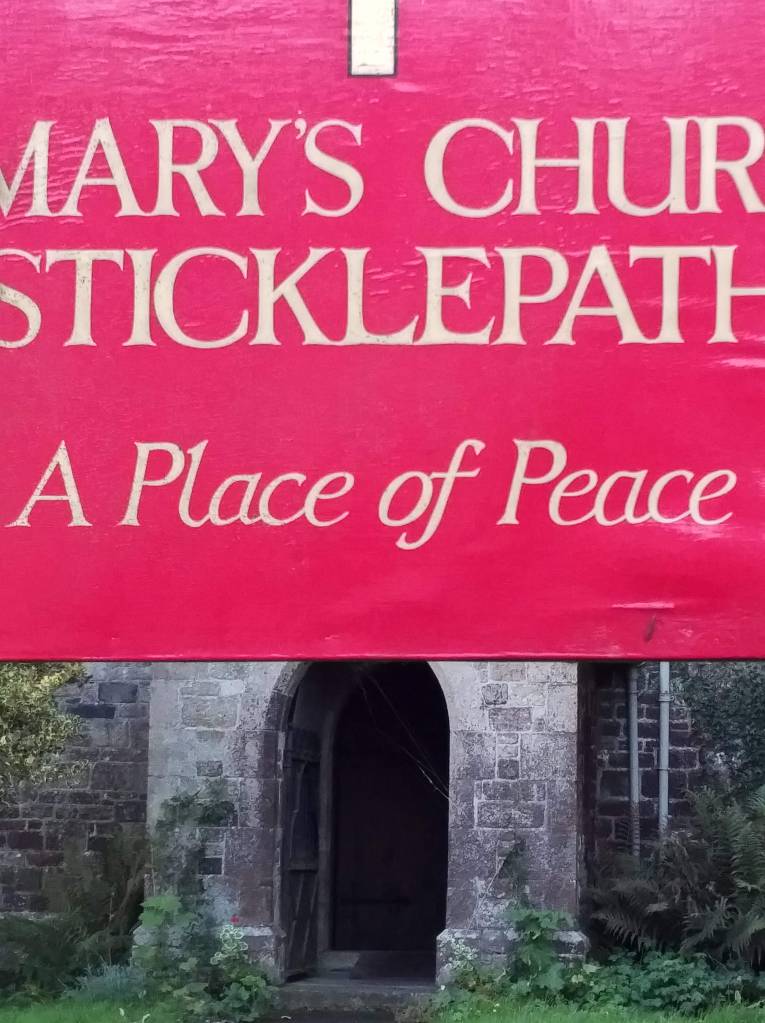
St Mary’s, Sticklepath (author’s photo)
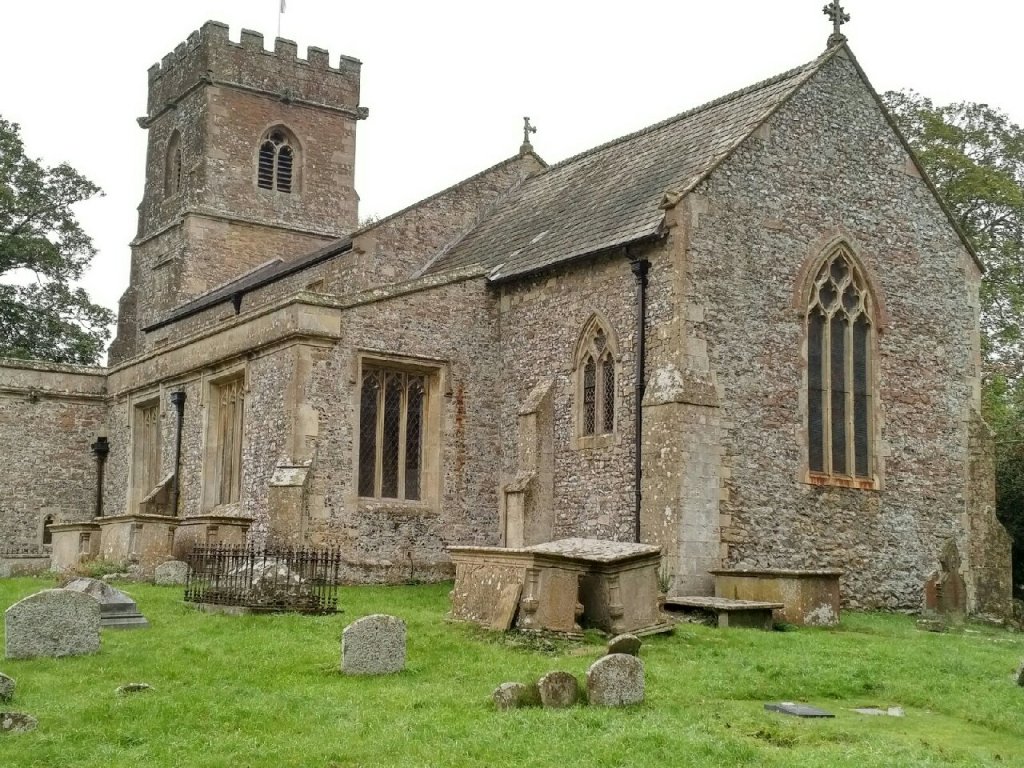
We followed the energies of the ‘newly flowing’ Mary current to the nearby village of Sticklepath, and blessed the energies as they pulsed through the lovely Ladywell at the entrance of the village. Walking along the road, we were delighted to find a church dedicated to Mary – and what a lovely jewel of a church it was! Beautiful stained-glass windows above the altar depicted Jesus and Mary the Mother with the quotes ‘behold thy mother’ and ‘behold they son.’ As it was my own son’s birthday that day, I found these words particularly moving. There was also a picture of the Magdalene at the foot of the cross, and our strong sense of this church resonating with the archetype of Mary the Mother and Mary the Lover (both being of course intimately linked) were confirmed on the back of the church sign, which clearly stated ‘Dedicated to my Mum!’
‘Dragon’ church, Throwleigh Church of the Virgin (author’s photo)
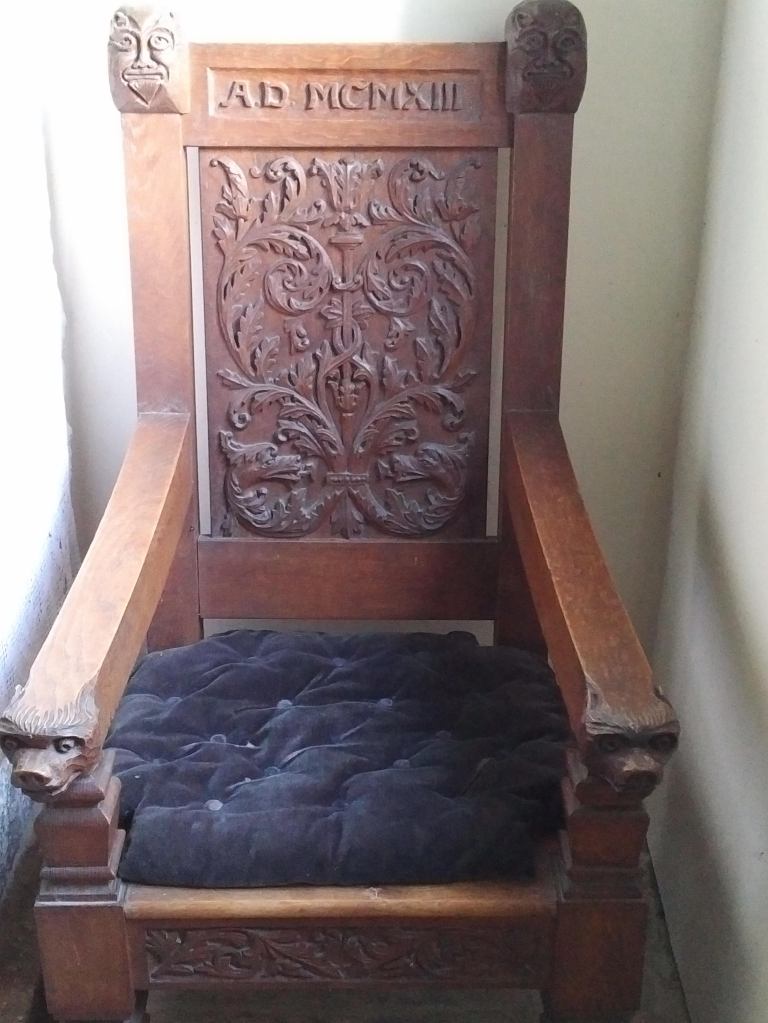
We continued to Throwleigh, the next village on the Mary current, and connected it in the Church of the Virgin, where Broadhurst and Miller had also sensed the flow of the Mary energy. This part of the Moor has a wild and isolated feeling, where the Earth energies feel untamed and free. In the church reached through an ancient stone porch, there was an ornately carved altar chair clearly depicting the tree of life and dragon energy. We drove on to Gidleigh where the remains of a church dedicated once again to the Virgin were said to be found but now the ruins have been incorporated into somebody’s house and are no longer accessible.
Spinster Stone, Shilstone (author’s photo)
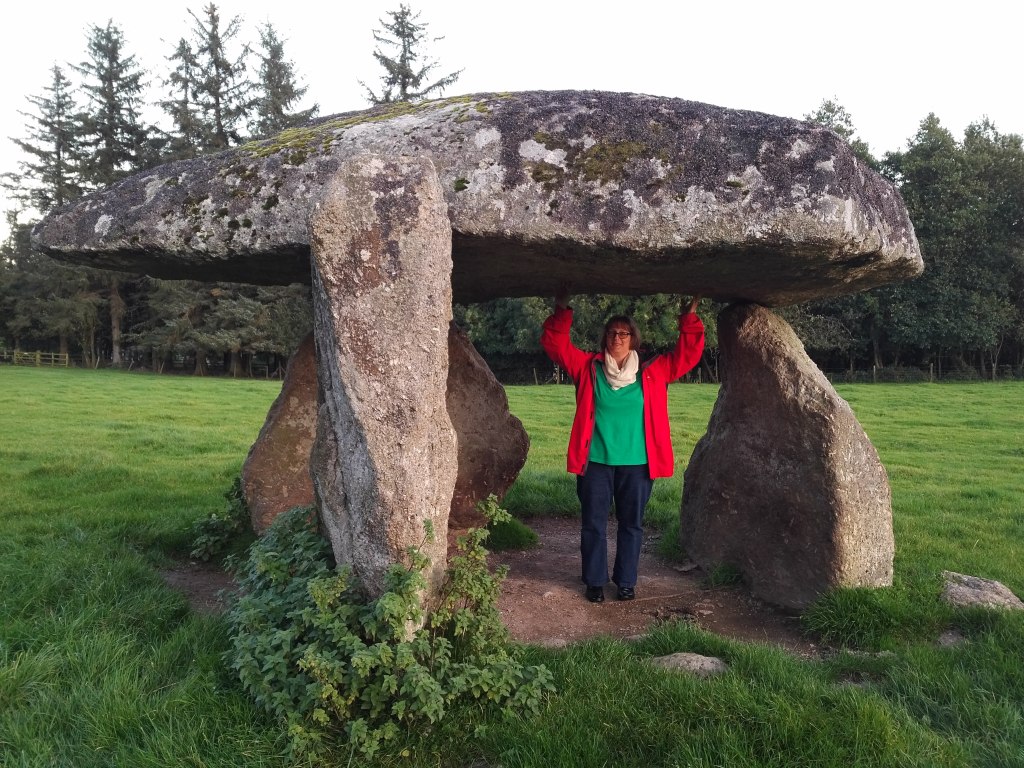
Our final stop was the Spinster Stone, where the Mary current loops down to Prestonbury Castle before leaving the Moor. This ancient dolmen standing in the middle of a field resonates strongly with the Mary energies for the three stones which held it up were said to symbolise the aspects of the triple goddess. It also happened to be right opposite our bed and breakfast at Shilstone Farm! Embodying the energy of the Mother, Maiden and Crone (though we weren’t entirely sure which was which), we celebrated the flow of feminine energy through the dolmen that we had physically brought down from the Nine Maidens circle, connected with the Mother energy at Sticklepath and then the Maiden energy at Throwleigh. Now standing in this burial place we fully resonated with the Crone aspect of the triple goddess, and the distortions associated with the name ‘spinster,’ the women who were originally the (childless?) spinners and weavers of destiny. As we watched streaks of purple and violet emerge across the sky and the moon rising behinds us, we felt a wonderful sense of embodiment of all of these energies, with the land beneath us, and with the heavens above.
[1] ‘The Sun and the Serpent’ by Hamish Miller and Paul Broadhurst, Pendragon Press, 1989
Stretching some 350 km from the far west of Cornwall to the east coast of Norfolk, the Michael Mary Line is probably the most famous ley line in the world. Also known as the St Michael Alignment, some of Britain’s most sacred sites are situated on it, as well as numerous megaliths and churches dedicated to either St Michael/St George (the dragon slayers) and St Mary (the christianised Earth goddess). John Michell first brought the line into awareness when he noticed the landscape alignments between the Glastonbury Tor and Burrow Mump in Somerset, both of which have churches of St Michael on their summits, but it was Hamish Miller and Paul Broadhurst who made it famous with their fantastic book of 1989, ‘The Sun and the Serpent.’ During an epic adventure to dowse the St Michael Alignment, the authors found the more subtle presence of a meandering Mary line, and discerned the existence of a long lost science that harnessed the energies of the Earth and Sun at cross-quarter days to fertilise, nurture and purify the Earth. One October weekend we set off to experience the energy of this special line for ourselves.
St George’s Church, Ogbourne St George (author’s photo)
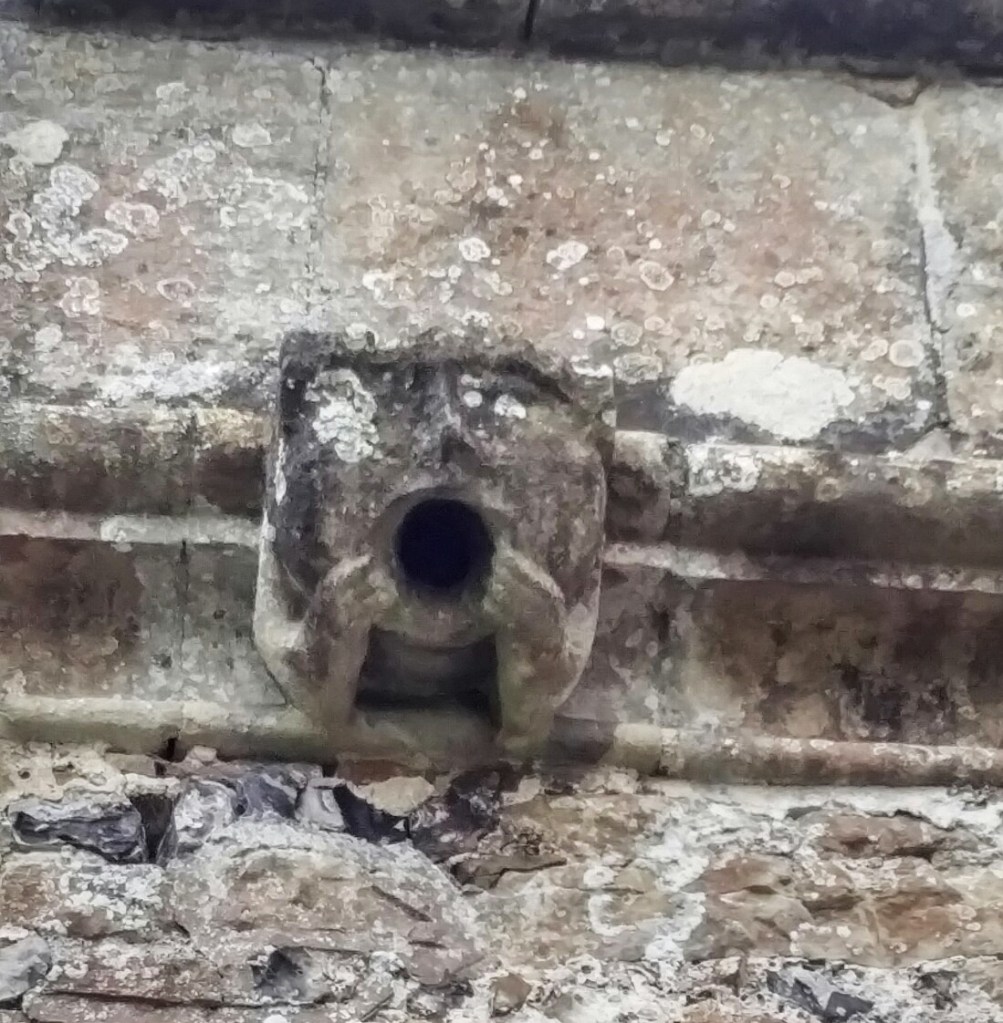
The nodes, or points where the Michael and Mary currents cross, were of particular interest to us so we decided to start our trip at the village of Ogbourne St George near Marlborough. We stayed at the Inn with the Well and after a hearty breakfast and close-up encounter with the energies of the well, we went to the church of St George to track the Michael line. A team of local ladies were busily decorating with flowers in preparation for the forthcoming harvest festival and the energies in the church were peaceful and nurturing. Outside, the presence of a sheela-na-gig style gargoyle hinted at a more pagan origin to the site.
sheela-na-gig at St George’s Church (author’s photo)
The church itself is near the Ridgeway, an ancient track that has been walked for millenia by pilgrims and travellers alike, and often intimately linked with the Michael Mary line as it was here. The Ridgeway runs along an ancient chalk ridge, and it is this chalk bedrock that gives the landscape its particular energies. Chalk is soft and would crack along the many ancient fault lines that lie hidden beneath the surface of the rolling hills, and it is also porous, allowing water to flow along these cracks. Where there is water, electromagnetic energy can flow, and this could affect the conductivity of piezo-electric rocks like quartz at the surface, or else attract a particular energy field to the area which can then be felt by animals and those sensitive to Earth energies.
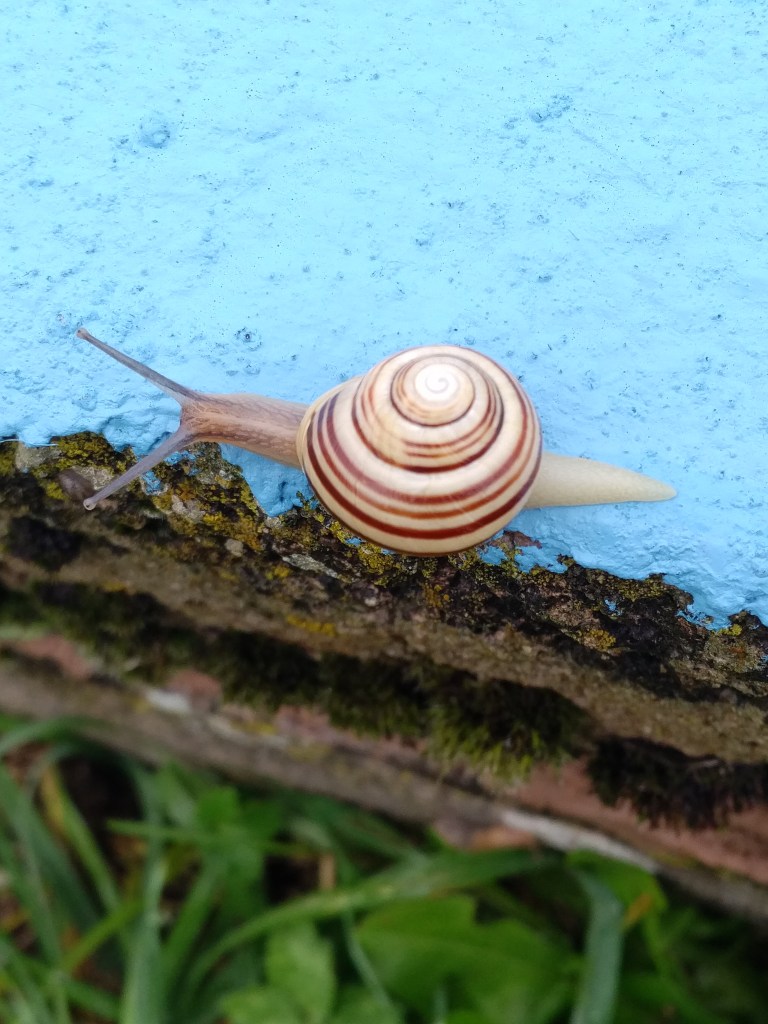
Snail on blue marker stone at the Sanctuary. The swirls on the shell were similar to the energy currents we felt there.
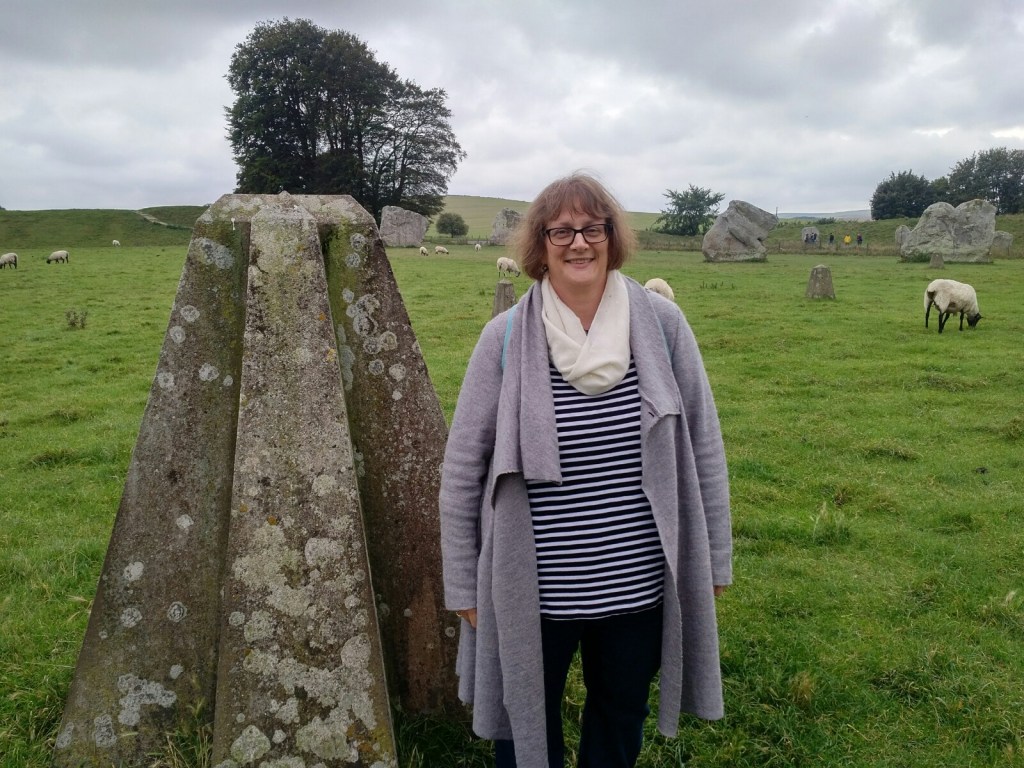
From Ogbourne St George it is a short drive to the next major nodal point of the line, the Sanctuary near Malborough. This ancient circular sanctuary is situated on top of Overton Hill, and dates back to around 3000 B.C.E. We could pick out the West Kennett long barrow and Silbury Hill in the surrounding landscape, and realised that the Sanctuary is unique as not only the Ridgeway but both the Michael and Mary currents cut across it. Later the stones of West Kennett Avenue were constructed to link this site to Avebury henge itself, reinforcing its use as a major ceremonial site. We could clearly feel the energies swirling in from the Avenue and the long barrow, and crossing over in the middle of the circle to form the head of the serpent before spiraling out back to Ogbourne St George from where we had just come.
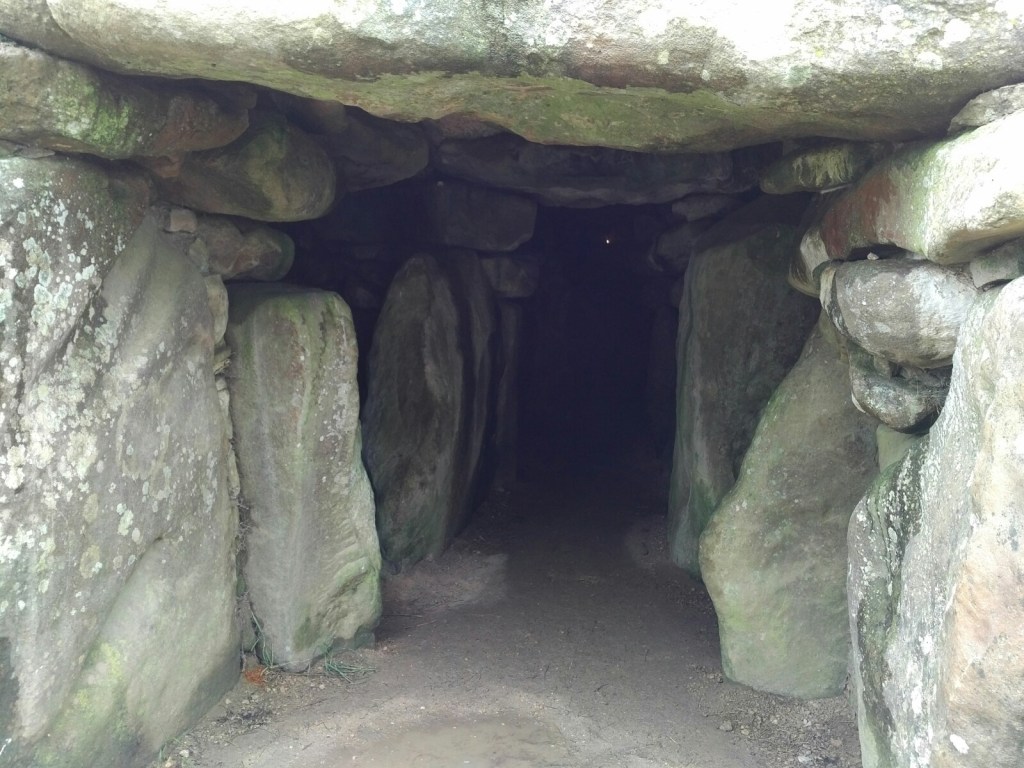
West Kennett long barrow, author’s photo
The nearby Swallowhead spring was dry and the Winterbourne stream that rises here and flows into the River Kennett was choked with weeds. This seemed to have an impact on the energy of Silbury Hill, the energetic battery of the landscape, which is driven in part by the flow of water from the underground streams. It is interesting to note that the name ‘swallow’ is a common term for rivers found in areas of intermittent streams, often in chalk, to explain how a stream disappears into the ground and erupts elsewhere [1] Thankfully the energy of the long barrow at West Kennett did not seem affected by this stagnation and the ancestral and dragon energies were clearly discernible in this ancient birth/death canal.
Cross over point of Michael and Mary currents at Avebury
We followed the path of the line up to Avebury and were amazed when our newly purchased dowsing rods showed us the exact spot where the Michael and Mary currents crossed and left the henge. It was such a pleasure and a privilege to walk freely round these stones dating back to nearly 3000 B.C.E and experience this serpent temple of great antiquity at close quarters, which is no longer the case at near-by Stonehenge. We could feel where the currents joined at the end of the avenue as they entered the enclosure, but they felt rather sluggish. Whether this was due to the lack of water in the Swallowhead springs area, or the fact that this serpent temple was no longer being used for its original purpose, we could not tell.
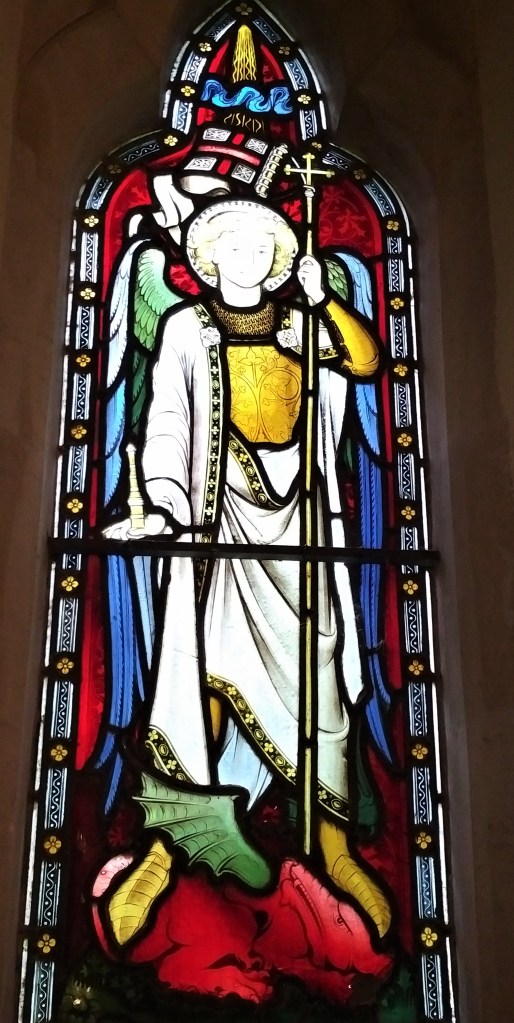
St Michael and the Dragon, Cadbury (author’s photo)
The Tor at Glastonbury has a similar exhausted feel, walked by many people but honored by few. The tower of the ancient church of St Michael still stands but feels haunted by the events of the Reformation when the last abbot of Glastonbury was hung, draw and quartered here by Henry VIIIs men. A reminder of the distorting energies of the Church, both Catholic and Protestant, mirrored by the image of Michael as the dragon slayer, depicted stamping on or killing the very energy of the line itself. The Michael Mary churches may have preserved the knowledge of the line, but the main intent of those who built them was to control and dominate.
According to Broadhurst and Miller,[2] the line with its azimuth of around 242 degrees is aligned to the rising Sun at Beltane, the ancient fire festival celebrated around the 8th May, and we were starting to realise just how powerful this insight was. All over the ancient world, bonfires would be lit to celebrate the power of the returning Sun as it fertilises and fructifies the Earth bringing forth a profusion of abundance and beauty. Furthermore, the fires were lit on top of the hills and mounds along the line, visible like beacons across the landscape, each one signalling the lighting of the next. In this way the power of the Sun (at the Beltane cross quarter point) would have been drawn down by the fires, then driven by the flow of water along the line, purifying and cleansing the Earth energies as it went. The people gathered in ceremony at the nodes along the line would themselves have been nurtured and nourished by the energies in a two-way flow that manifested in the bounty of nature around them. All would have been well in Heaven and Earth, bringing a sense of harmony and well-being that we no longer have in our disconnected modern world.
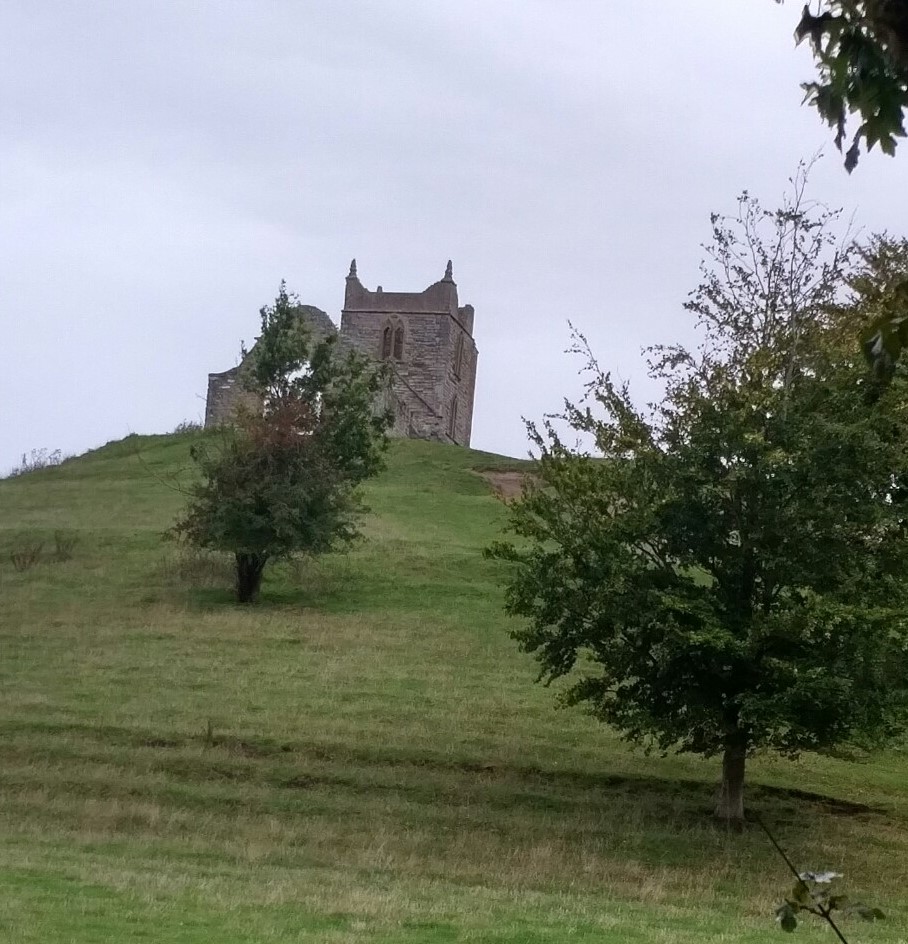
Michael Church, Burrow Bridge Mump
Away from Glastonbury we climbed the mump at Barrow Bridge and found our next nodal point. The church of St Michael on top is now partially ruined, but we could sense the Michael and Mary currents as they crossed over where the altar once stood. The energy was here clearer, less distorted, but still weak from lack of use. Gazing across the Somerset levels, we could see the Tor looming in the distance and visualised the energy flowing strong across the landscape towards it, so that the energy could flow back from Glastonbury like an alternating current generator. We had connected up the line from Ogbourne St George in Wiltshire right across Somerset and it was feeling good. As the day drew to a close, we headed off west in the direction of the setting Sun towards Dartmoor for the next part of our journey.
The ancient rocks of the Lizard ophiolite complex in Cornwall
are amongst the rarest in the world, preserved when a small sliver of oceanic
crust was thrust over more buoyant continental crust after the collision of two
continents. Distorted and gnarled, in patchworks of pale green, hues of crimson
and jet-black streaks, the rocks of the Lizard resemble the scaled hide of a
reptile. Lenses of serpentine form perfect loops like the eye of a dragon, all
seeing and all knowing, recording in every hue, every twist and turn, the
ancient history of our planet.
Mullion Cove, author’s photo
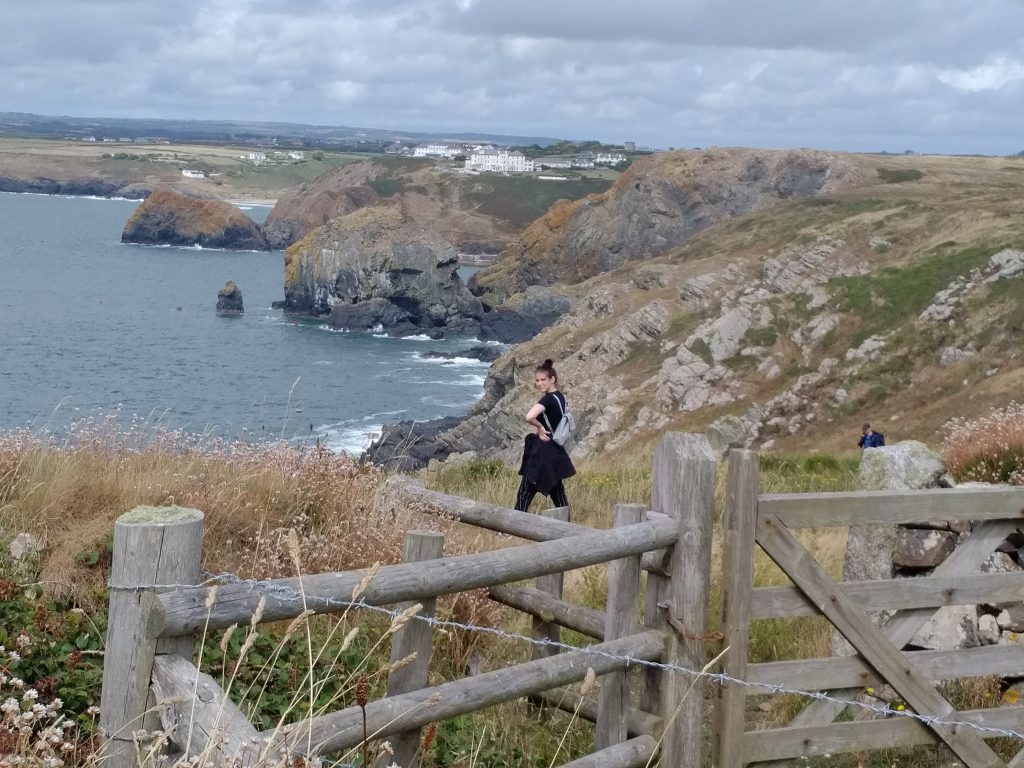
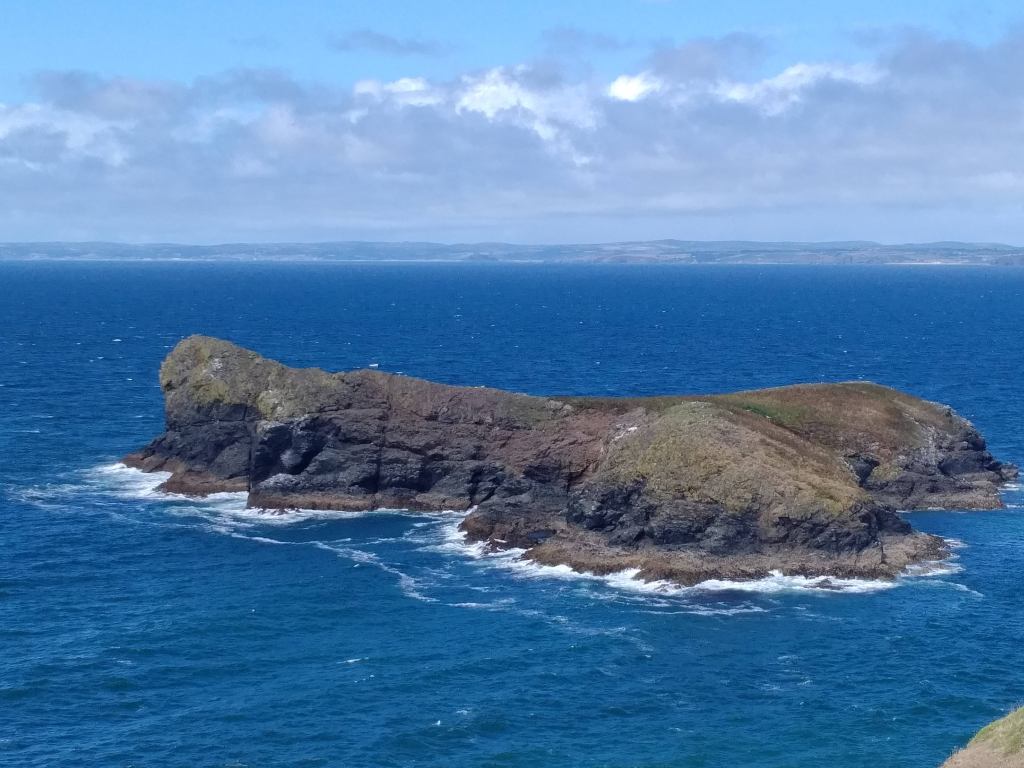
At Kynance Cove the lizard-hide gleams wet and shiny from the constant pounding of frothy white Atlantic swell. Families come and jump the waves, then scramble across the huge ancient blocks of peridotite that were once deep inside the Earth. Further north at Mullion Cove a huge fault is visible in the harbour wall, a cosmic crack resulting from the strain and twisting of the tectonic plates. Comparable to the filling inside a sandwich, the fault lies squashed between metamorphosed serpentine and gabbro pressed and squeezed up like toothpaste from a tube. Out to sea, islands comprised from the pillow lavas that would have lain on top of the ophiolite sequence loom like dragons from the depths.
Yoni of the Dragon at Lizard Point, author’s photo
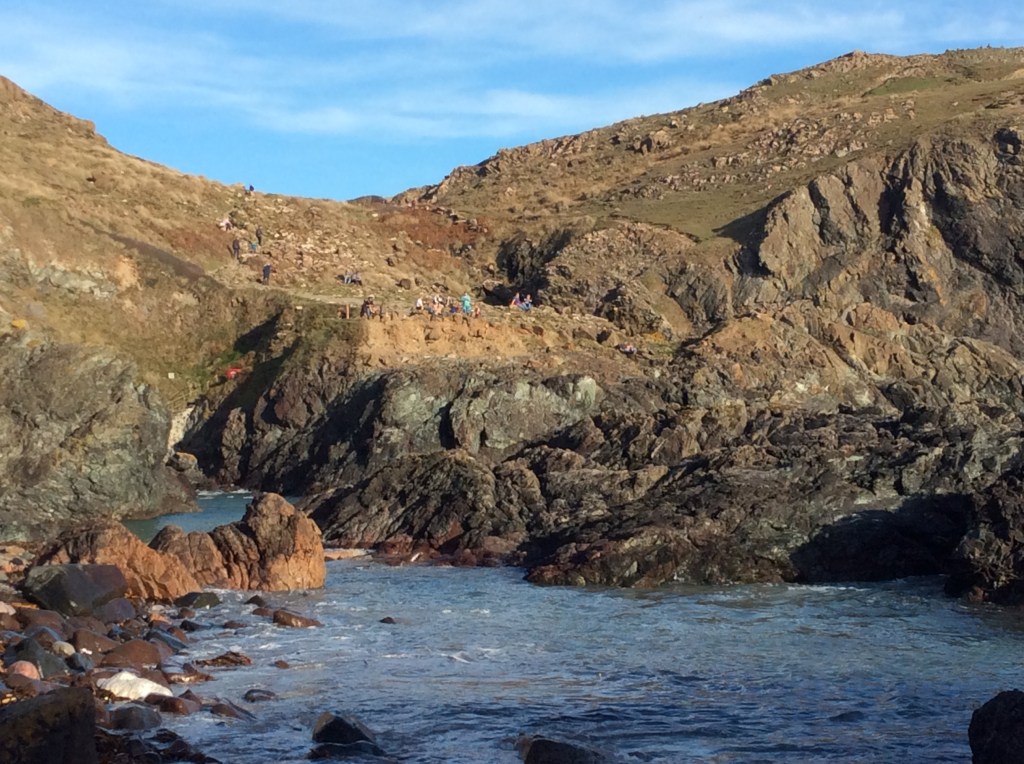
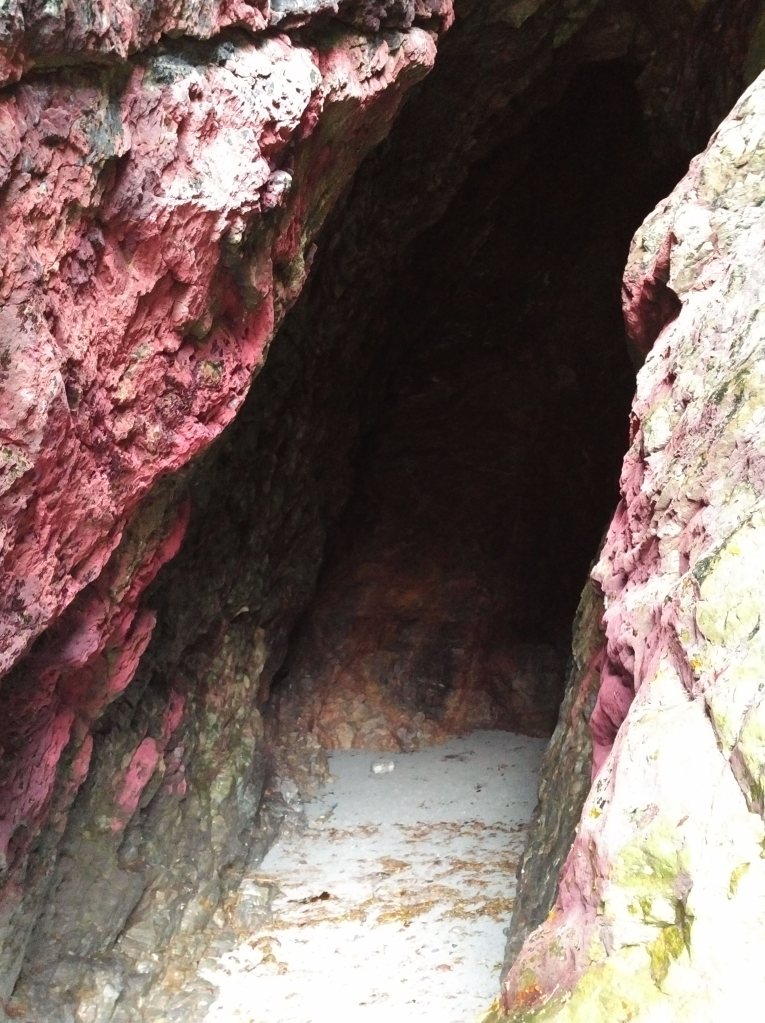
At Lizard point itself some of the most ancient rocks in Cornwall are to be found. The 500-million year-old Man of War gneiss, and a series of meta-sediments, mainly schists, have undergone extensive metamorphism and deformation here, bearing witness to the powerful Earth energies at work. On the beach underneath the lighthouse on the most southerly piece of land in the UK and accessible only at low tide is the yoni of the dragon, a large almost triangular slit in the rock, splashed crimson like blood. A pile of seaweed lying at the entrance defies all but the bravest to enter. Under the August sun the rubbery looking mass had started to move, seething with maggots hatching out in the warmth!
The ophiolite on Coverack beach, author’s photo
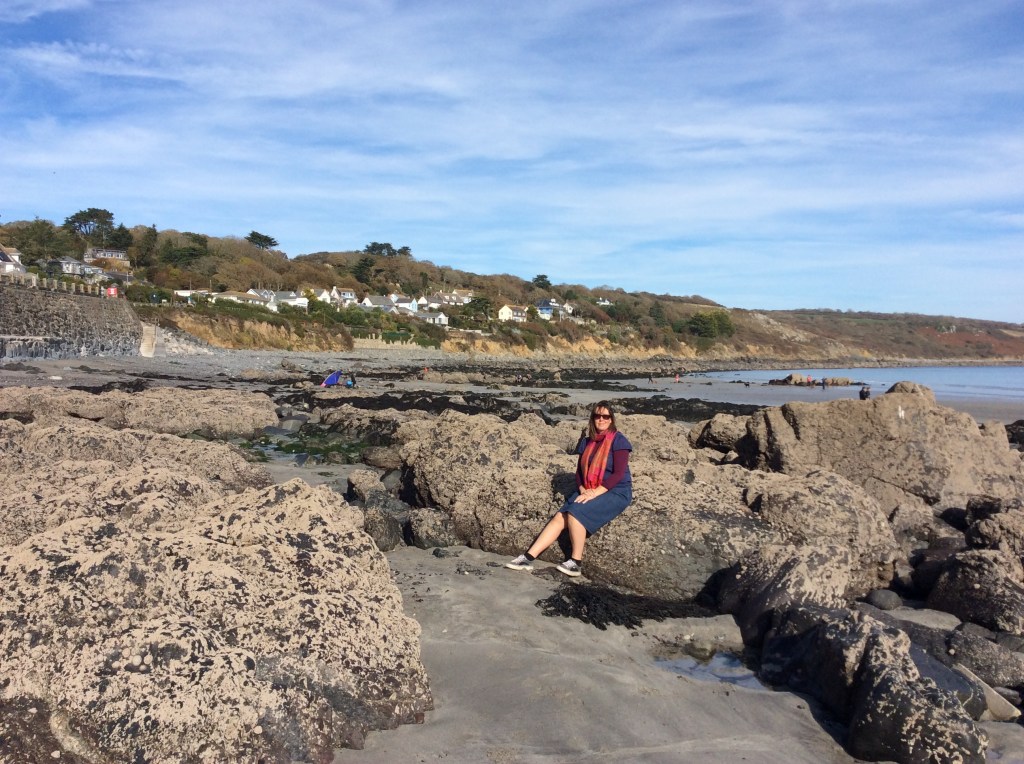
But it is Coverack that hides the Lizard’s brightest gem. This beautiful 200 m stretch of beach preserves a uniquely preserved sliver of the ophiolite – and an opportunity to touch the Moho, the transition zone between the Earth’s crust and its mantle. The lower part of the beach is made from dark magnesium and iron-rich gabbro that would once have laid on the ocean floor. The upper part is peridotite, an ultramafic rock that originates from the mantle, and between the two lies the transition zone, the Moho, usually at depths of around 25 km and therefore rarely seen, let alone touched. To walk this beach is like walking on the inside the Earth, coming into contact with something that is out-of-sight yet familiar, almost like touching your own inner organs.
Standing on the Moho, author’s photo
The ancient serpentine rocks of the Lizard retain a pristine
Energy that connect us deep into the soul of the Earth, opening up our lizard
eye in the back of our heads and accessing our primal or reptilian brains, where
all is recorded but not always known. Indeed according to local legend, the
serpentine rock is an embodiement of the Old Dragon herself, the serpent of the
rocks that manifests as an Earth energy known as ‘snake breath.’
Mullion island pillow lava, author’s photo
This ‘snake breath’ is so strong as to be palpable and send currents of energy through the rocks. Indeed, many people have dowsed these currents and found extraordinary associations between the manifesting Earth energies and the man-made building above them, including ancient sites, churches and monuments. I was therefore intrigued but not surprised when I saw that Broadhurst and Miller, master dowsers of Earth energies, had found that what they call the Apollo and Athena currents snake across the Lizard before leaving the British mainland on an epic journey through continental Europe and ending up at Meggido in Israel.
Sunset at Gunwalloe, author’s photo
As recorded in their amazing book ‘the Dance of the Dragon,’
after spiralling round that huge energy nexus point at St Michaels Mount, the
Apollo current meanders through rock promontories at Prussia Cove and Trewas
Head in the north of the Lizard, before emerging in the tower at Gunwalloe Church Cove, where it crosses over with the
more ‘feminine’ Athena current and is amplified by it. This beautiful old
church sits right on the beach and faces west across the sea, the perfect place
to watch the sun go down and experience the kiss of the dragon at first hand.
Radio mast at Poldhu, author’s photo
Intriguingly the Apollo current also crosses Poldhu, a place made famous by the world changing experiments of Guglielmo Marconi, who successfully transmitted the first trans-Atlantic radio signal here. On the 12th December 1901, three dots of morse code were sent from the Poldhu radio mast and successfully picked up by a transmitter in Marconi’s ear, himself 2000 miles away in St John’s on Newfoundland at the time. Nobody would deny that his insights turned out to change the course of human history, but it is interesting to speculate, as Broadband and Miller[1] did, whether he owed his inspiration to the ‘snake breath’ of the Lizard where he spent so much of his time. It can be no coincidence that the letter transmitted across the Atlantic was, of course, ‘S.’ The hisssss of the snake, or the ‘snake breath,’ could now be heard as well as being felt – and indeed heard it was, right across the other side of the world.
[1] ‘The
Dance of the Dragon: An Odyssey into Earth Energies and Ancient Religions’ by Paul
Broadhurst and Hamish Miller with Vivienne Shanley and Ba Russell, MYTHOS, 2003
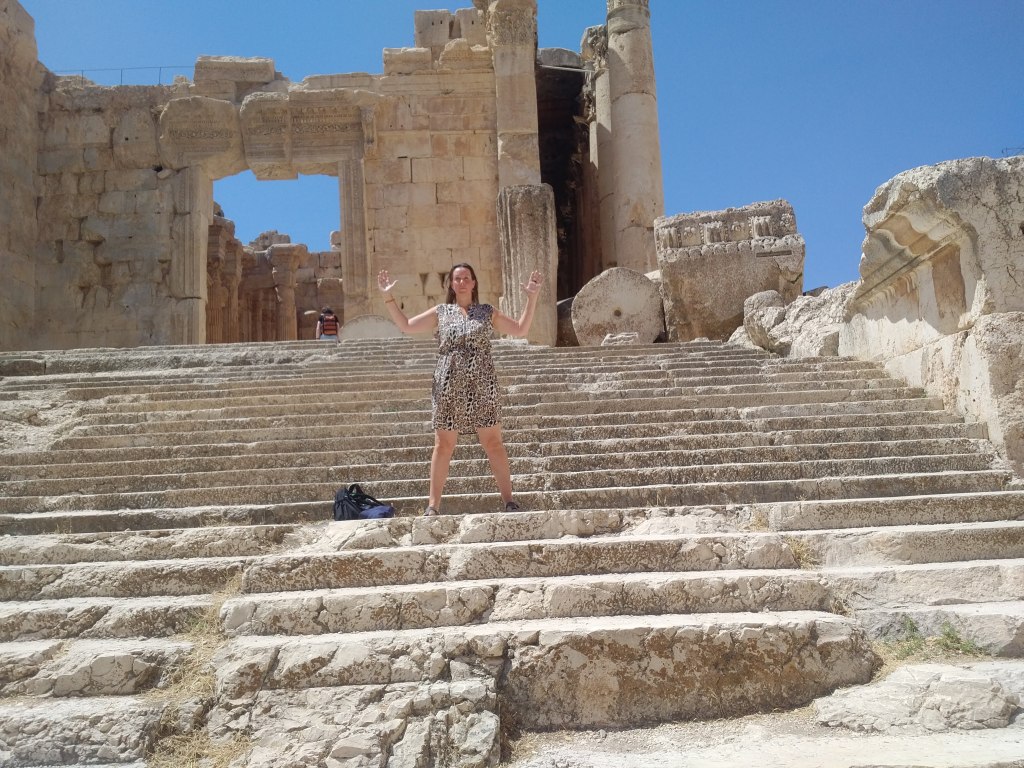
The sanctuary of Baalbek was one of the most famed sites of the ancient world and the well-preserved ruins are still capable of inspiring awe and wonder to this day. Roman emperors would make pilgrimage to the largest of Rome’s temples, situated not in the Eternal City, but in a remote valley sandwiched between the Lebanon and ante-Lebanon mountain ranges. Though Baalbek is still a major attraction, for decades its proximity to the Syrian border and a nearby Hezbollah training camp have made it largely inaccessible to all but the hardiest of travellers. Now, as tourism returns to the Lebanon, its mysteries are again being slowly revealed.
The Propylaea, author’s photo
Nobody would deny that the Romans were master builders, the engineers par excellence of the ancient world. It took the Julio-Claudian emperors over 200 years to build the sanctuary that consists of temples dedicated to the Roman triad Jupiter, Bacchus and Venus, plus two massive courts, sacrificial altars and basins for ritual cleansing. The vast scale of the complex, the intricacy of the decoration and the sheer height of the six remaining Corinthian columns of the Temple of Jupiter, the largest in the Roman world, cannot fail to impress. Still, the enigma of Baalbek lies not so much in the wonder of the temples, but in the presence of three gigantic stones comprising part of the wall that surrounds them.
The Trilithon, photo public domain
Approximately 64 feet long, 14 feet high and 12 feet the three stones embedded in the north end of a U-shaped megalithic wall surrounding the Temple of Jupiter are collectively known as the Trilithon. They have been laid with such a precision that ‘even a needle would not fit in between them,’ yet each stone weighs in excess of 800 tonnes, weight that even modern cranes would struggle to move[1]. So, who put them there, how did they do it and what purpose did they serve?
The theories are many and varied. Though the Romans have left no written record of how the Trilithon was moved and why, the most standard line is that it was them who emplaced them, intending the U shaped wall to form part of a podium which presumably was never completed, which in turn incorporated the remains of an even earlier podium[2]. Another theory is that the Romans built the megalithic wall as a restraining wall to stop soil erosion and prevent movement on the vast temple complex [3]. Other researchers doubt that the Romans had the technology to move the massive blocks from the nearby quarry and attribute the building of the wall to an Elder culture who had highly developed building skills learnt before the Great Flood, and who could have also built another Cyclopean structures around the globe.[4] Other theories credit the construction and engineering of the Trilithon wall to giants, jinn or extra-terrestrials who used magnets and sound technology to move the stones.[5]
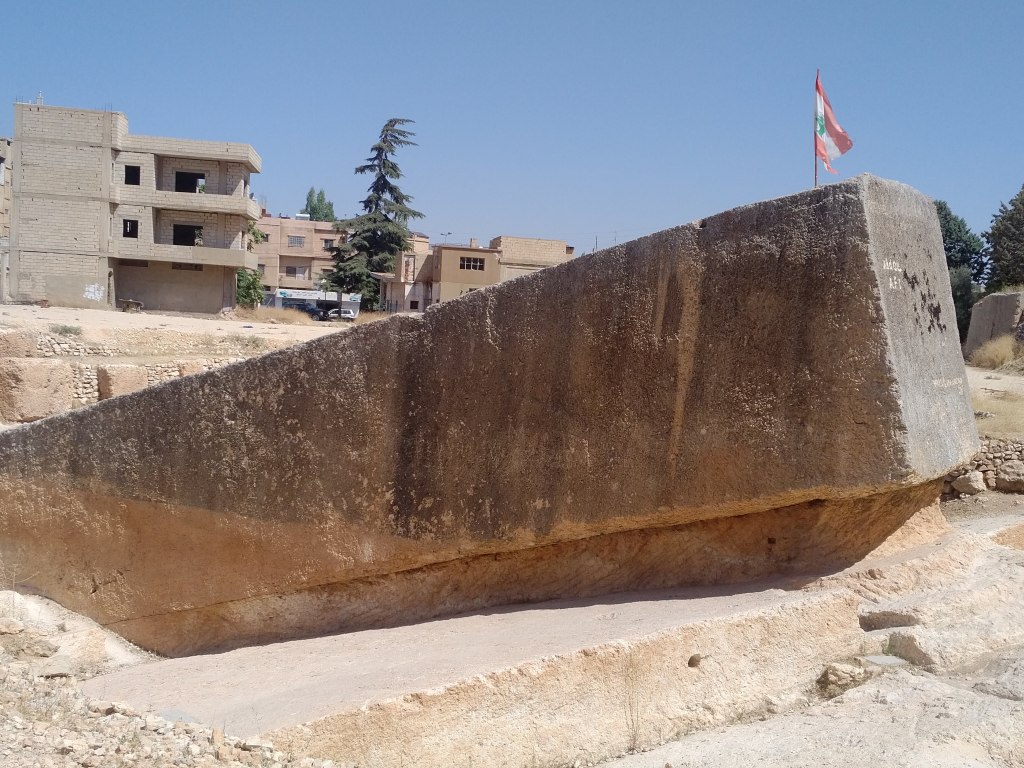
‘The Stone of the Pregnant Woman in the quarry near Baalbek, author’s photo
Many researchers more qualified than me have pondered deeply about the logistics of moving and emplacing such massive stones, but surely that the Romans possessed the know-how to move gigantic blocks and emplace them is not in doubt, as the massive columns in rest of the sanctuary testify. And they could also have simply built the megalithic wall as a retaining wall, practical as they were. But I am equally comfortable with the notion that an earlier culture could have built the wall too, and that massive structures in Egypt and South America show levels of engineering capabilities that equalled, even surpassed, that of the Romans. New and intriguing structures from prehistory are coming to light all the time (e.g. Gobekli Tepe in Turkey) and gradually we are able to flesh out in more detail the mysteries of our past. But for me, after the visiting the site, the enigma of Baalbek changed from how and by whom, to why and why here?
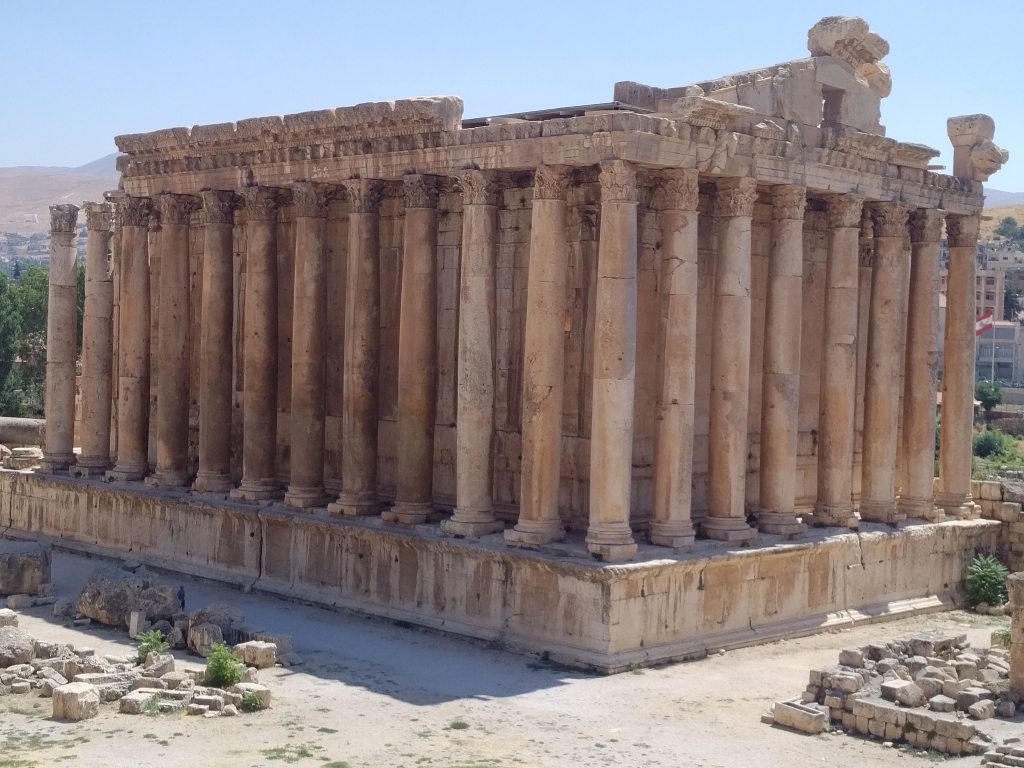
Temple of Bacchus, author’s photo
So, who was here before the Romans? Everyone would agree that Baalbek was considered sacred long before they arrived. Named Heliopolis by the conquering Alexander, the Greeks equated it with the Egyptian City of the Sun, a place of great antiquity by this time. The Canaanites had been present in the area for centuries and used the hill at Baalbek as the centre of one of their sanctuaries. And the Phoenicians, an off shoot of the Canaanites, also considered the site to be sacred and built temples to Baal, Astarte and Adon(is), here. Indeed, the altars of the Roman Great Court were built over the exact summit of the hill used as one of the Canaanite ‘high places’ and care taken to raise the platform so it was the same height. Archaeological evidence has shown almost continual occupation of the tell over the past 9,000 years and evidence of occupation during Paloelithic times has also been found.[6] But why here?
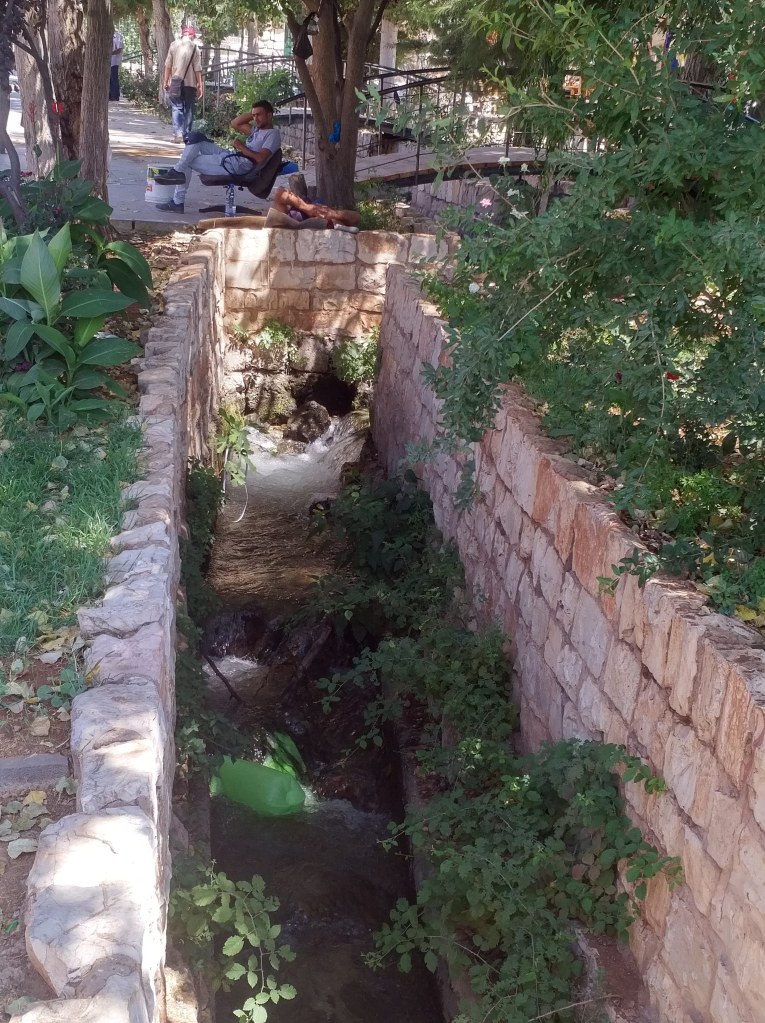
Spring at Baalbek, author’s photo
Next we need to look more carefully at Baalbek’s location in the Beqaa Valley and dig deeper into the local geology. Located in the centre of the cradle of civilisation, the NE Beqaa was a cross over point on trade routes from Tyre to Palmyra in the Syrian desert, or from Damascus to Beirut, bringing a constant flow of people and ideas to this area that was known for its fertile soil. It is located between two mountain ranges, and close to the source of two rivers, the Litani and the Orontes, was deemed highly auspicious by the ancients, and one of the possible locations for the abode of El in the Ugaritic Baal Cycle.[7] Finally, Baalbek is also near a well now called Ras al Ain (‘head of the source’), which in ancient times was associated with the dragon Typhon. [8]
Dragons are usually associated with very powerful Earth energies, and this is an apt description of the Beqaa Valley. Situated at the top of the Great Rift, the valley is in close proximity to (indeed was pushed up by) a long fault line that runs through the Lebanese mountain range bringing frequent earthquakes to the region as the converging African, Eurasion and Arabian microplates twist in opposite directions. The power of nature in this region is literally awesome and must have inspired wonder, and not a small measure of fear, in our ancestors. In addition, the natural springs fed by meltwater runoff from the ante Lebanon mountain range frequently overflow, bringing flooding as well as earthquakes to the Beqaa.
As a site of potent Earth and water energy, Baalbek was also
an oracular site of great antiquity. The Romans took over this cult wholesale
and used the Temple of Jupiter as an oracle, famously consulted by the Emperor
Trajan on two occasions, who asked if he would be victorious against the
Parthians. It was also a site of cosmic importance, for there are reports from
travellers that the Canaanites had a temple housing the sacred ‘betyl’ or
meteorite stones that ‘were endowed with life’ and probably used for oracular purposes.
[9]
Thus as a place of great dragon and water power, as a sacred link between
heaven and Earth, Baalbek was clearly a sacred site par excellence.
Entrance to the Temple of Bacchus, author’s photo
It is well attested that the natural calamities that befell the people of the Bronze Age resulted in a shift in human focus from living according to the principles of nature, to attempting to dominate. My sense is that the megalithic wall, and massive Trilithon stones, were emplaced for this reason, to try and control the vast and awesome forces at play in the Valley. Whether the Romans built the megalithic wall or not, they certainly built to impress and dominate, harnessing the power of the potent sun god (Jupiter) and the wild god of bacchanalia (Bacchus) to this end. To build such an imposing monument on this site of great Earth energy was clearly deliberate.
Over the past two thousand years, many more earthquakes and flood have ravished the land, and waves of conquerors have passed through, leaving their own mark. In more recent times, politics and agendas in neighbouring countries have become more intense and today the Beqaa Valley is one of the most poignant places in the Middle East. Though still a place of natural abundance and beauty, warlords use the land to grow cash crops of cannabis, marijuana and heroin, and Syrian refugees live in makes shift tents and farm the land in all weathers to earn money to send back to the ruin that is now Syria. Pictures of Nasrallah and the yellow flags of Hezbollah line the streets, and the Israelis nervously monitor the training camps that give the valley the name ‘barracks of Hezbollah.’ According to a recent article in the Jerusalem Post [10], Hezbollah are building a precision missile building site here, but I have no means of verifying this (itself a sign of our times).
Once one of the most sacred places in the Middle East, it now feels like one of the most distorted. This to me is the true enigma of Baalbek and the key to this lies not in understanding the technology used to shift large stones, but in the intentions used to emplace them.
[1] Graham Hancock, ‘Magicians of the Gods’ p. 239 – 291
[2] Graham Hancock, ‘Magicians of the Gods,’ p. 239 – 291
The Lebanon is not your average Middle Eastern country, though it
embodies aspects of them all. Today it is a melting pot of Sunni and Shia
Muslims, Palestinians, Druze, Maronite and Orthodox Christians, Syrian refugees
and wealthy Arabs from the Gulf, but beneath the vibrant surface it is possible
to discern the traces of an equally unique and rich past.
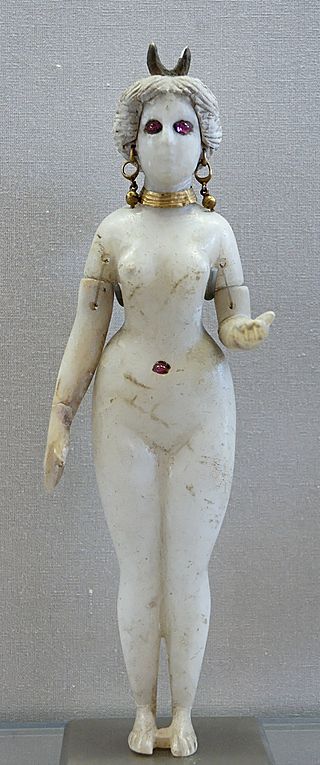
‘Astarte’ the Louvre, Paris (public domain)
For thousands of years it was the Canaanite and then Phoenician cultures that flourished in this tiny sliver of land sandwiched between the Mediterranean and two large mountain ranges. This was the time when Astarte, Queen of Heaven, was worshipped as a goddess of fertility and sexuality, bringing abundance from the sea and nourishment from the land, and ensuring together with her consort Baal, that all things were in balance above and below. She herself was derived from the older Mesopotamian goddess Inanna and it was this archetype that was worshipped throughout the Levant in various forms including Ishtar, Ashtoreth and Aphrodite.
‘Jezebel’ by Byam Shaw, public domain
Today little traces of her remain either physically or in the historical
record, and what does is often recorded through the lens of disapproving
historians or biblical writers. One of her most famous priestesses was Jezebel,
the Phoenician princess and daughter of King Ethbaal of Tyre, who took the
worship of both Astarte and Baal to the kingdom of Israel at the time of the
prophet Elijah. Astarte ruled supreme in all the city states of Phoenica and in
the Eschmoun temple near Sidon (named after her consort in this city), a well-preserved
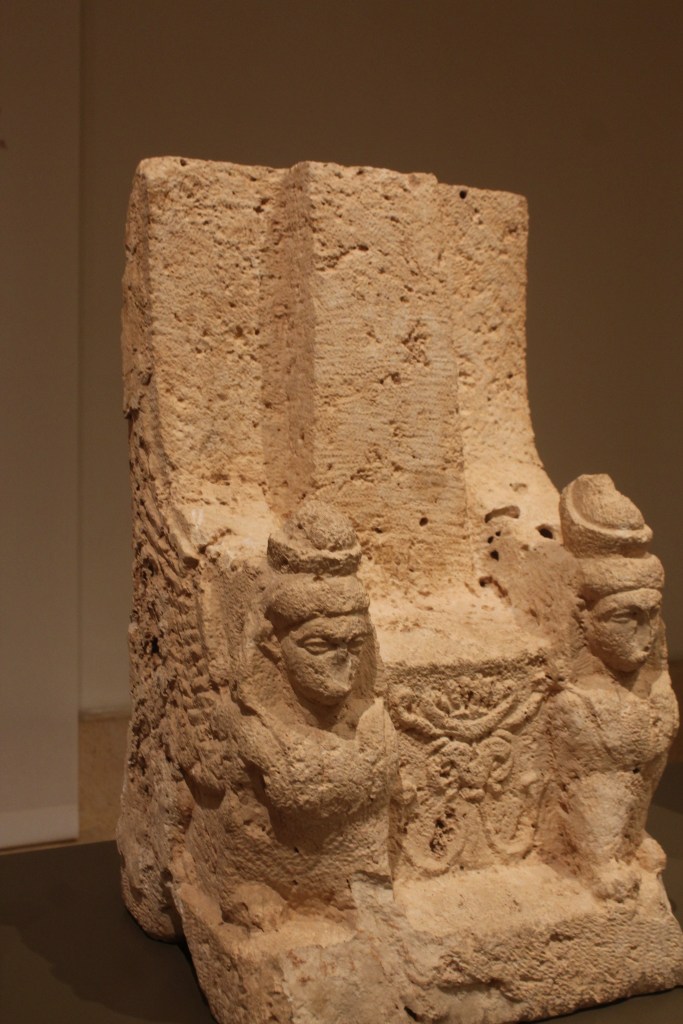
temple still stands to this day. She was typically worshipped in the form as a
throne supported by winged sphinxes or lions, and represented by a betyl, or
sacred stone. It was at Byblos, however, that her main centre of worship was located
and it was there that I went to piece her story together.
Astarte’s throne, National Museum Beirut (author’s photo)
The ancient ruins of Byblos are vast and impressive and in the centre of
the complex, reached by a grand central colonnade, the temple of Astarte once
stood. Reconstructed images show a large open court, surrounded by cloisters,
in the middle of which stood a large conical shaped stone, or betyl, that
represented and embodied her essence. It was here that the famous rites of
Adonis were celebrated, generally seen as the ‘offspring’ of Baal and Astarte,
or sometimes as her lover. The name Adonis means ‘lord’ in semitic and though introduced
at a later stage by the Greeks and Romans, nevertheless embodied a hugely
powerful archetype that also went under the names of Tammuz and Attis.
These young male gods embodied the ‘rising and dying god-man archetype,’ an archaic form of a vegetation deity that has very deep roots. According to James Frazer[1], as harvest gods, they embodied the actual life essence present in the corn and were ritually slain once a year as the corn itself was threshed by scythes and cycles at harvest time. The death of the harvest god was then ritually mourned in a huge ceremony involving cymbals, flutes, and semi-naked women beating their breasts, dancing and weeping in a sacred lament, followed the burial of his wounded body, and then the celebration of his miraculous resurrection the following day.
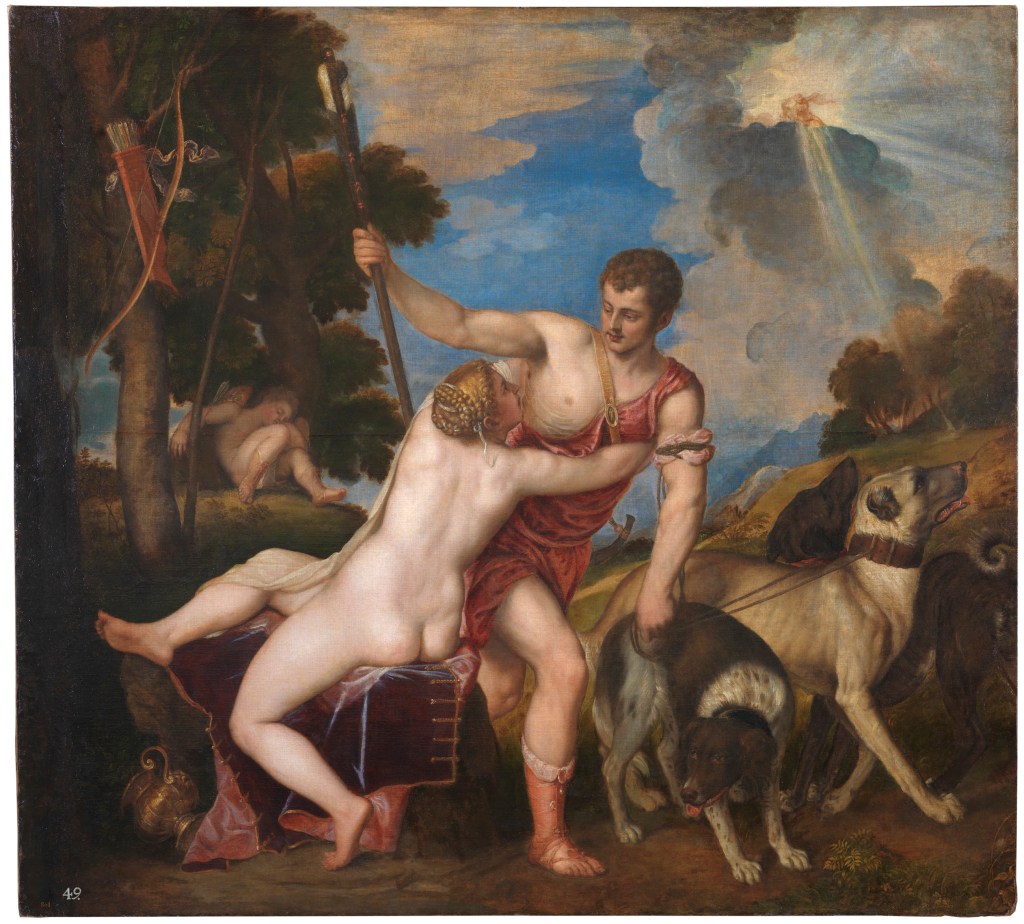
In the Greek version of the legend, Adonis was born of a myrrh tree (confirming his status as a vegetation deity) and hidden in a box by Aphrodite in the underworld. In a story woven into the mythology of many cultures across the aeons of time, but with local varieties of gods/goddesses playing the part, he is held hostage in the underworld until permitted by an authority figure to spend part of the year above ground, thereby embodying the mysteries of the seed that lies fallow before bursting forth in the spring in the abundant glory of the corn crop.
‘Venus and Adonis’ by Titian, public domain
The next part of the legend is specific to the Lebanon, for we are now
told that the youthful Adonis, who loved to hunt, was out on Mount Lebanon near
a place called Afqa. He came across a wild boar, that fatally wounded him in
the leg. Aphrodite herself could not save him from his injuries and he bled to
death on the ground, causing crimson anenomes to spring forth and the river
water to run red with his blood. This river was known as the Adonis river in
antiquity and flowed from Mount Lebanon through the Aphaca gorge down to
Byblos, where it emptied into the sea.
Afqa waterfall, author’s photo
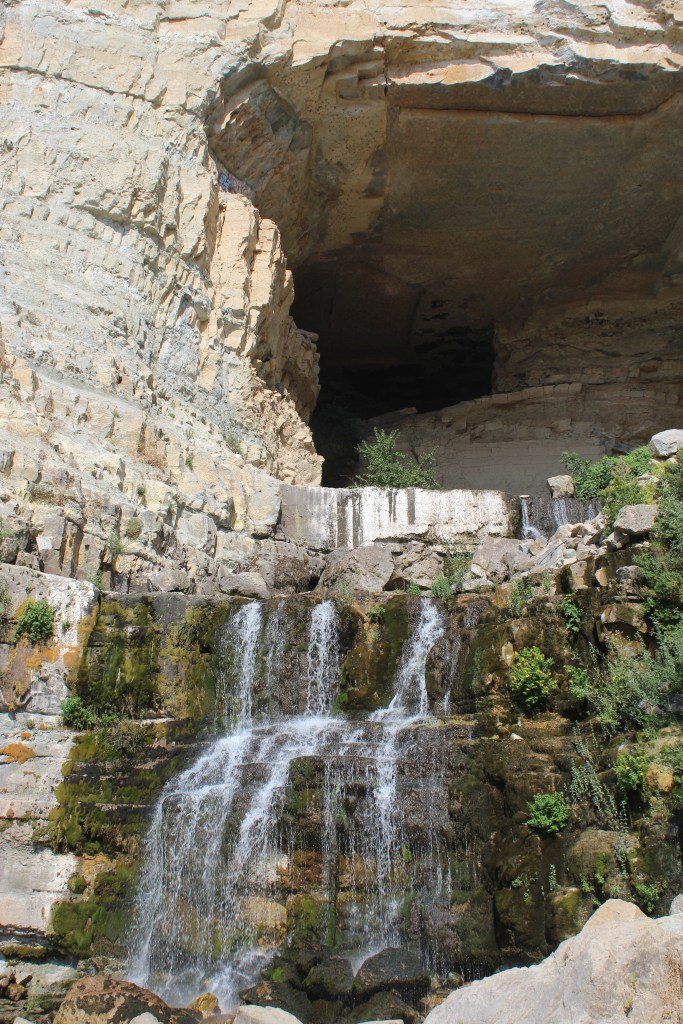
According to Frazer, there was once a large temple of Astarte that stood in a grove near the source of this river, and one hot day in August, I journeyed to Afqa to see what fragments remained. Though I found no trace of the temple, I did find a place of incredible beauty. Set in the towering limestone massif of the Mount Lebanon range was a huge cavern from which a waterfall emerged. Even in August the waterfall was an impressive site forming pools of azure and turquoise water, but in the spring, when the pale sun starts to melt the snow on the top of Mount Lebanon, the frothing waters would have burst forth in torrents, cascading down the valley, fructifying and turning all the vegetation green after the barrenness of winter. It was here, according to the legend, that the wounded body of Adonis was buried, dying so that the vegetation might spring forth.
It is clear from the stories that the blood of Adonis not only fertilised the land but also turned the river red. Upon closer inspection of the waters, traces of iron can be seen and we now know that the soil around the river is rich in iron oxide. As the water levels rise, iron rich soil is washed into the water, turning it the colour of vermillion. This bloody torrent then then snaked down the Aphaca gorge, and on to Byblos where it fanned out to sea, and, in the words of Frazer, “fringing the winding shores of the blue Mediterranean, whenever the wind set inshore, with a sinuous band of crimson.’
Adonis Cavern, Afqa (author’s photo)
And that is not all. As also Frazer suggests, there was a celestial event that accompanied the torrents of water that emerged gushing like blood from the cavern at Afqa, and this could be linked to the planet Venus. According to the historian Sozomen [2] ‘At Aphaca, it was believed that on a certain prayer being uttered on a given day, a fire like a star descended from the top of Lebanon, and sunk into the neighbouring river; this phenomenon they sometimes call Urania, and sometimes Venus.’
Astarte/Aphrodite were closely associated closely with the planet Venus, and the cycles of Venus were well known to the Ancients who considered her retrograde motion then reappearance as the morning star to be mysterious and sacred. It is therefore plausible that at certain times of the Venus cycle, the star was seen from the lofty heights of Mount Lebanon to fall from the night sky and plunge into the river, turning the waters blood red. To the ancients, Astarte would have personified the planet Venus, who fell from heaven to lie in the arms of her lover Adonis, fructifying the barren Earth in a cosmic drama of great potency.
Throne of Astarte at Echmoun Temple, Sidon (author’s photo)
On an even deeper level, it is possible that these rites originally recorded a meteorite impact that occurred in archaic times. Then the falling ‘star’ would have had a physical impact on the Earth, ‘wounding’ it and causing the river to run red with blood. It could also have fructified and brought forth new life, just as the poppies used today to symbolise death and sacrifice rose from the desolate battle fields when they were first ploughed. Furthermore, Astarte herself was represented by a betyl, and the most prized betyl of all were those made from meteorites. They truly were a piece of heaven on Earth and our ancestors understood their significance in a way that has been lost today. In the stories and legends that have come down to us from antiquity, we can therefore piece together traces of a lost world view that saw heaven and earth as a unified whole, and our place in nature as sacred and wondrous.
[1] James
George Frazer ‘The Golden Bough,’ Oxford University Press, 2009.

















 Earth Wisdom Earth Science